
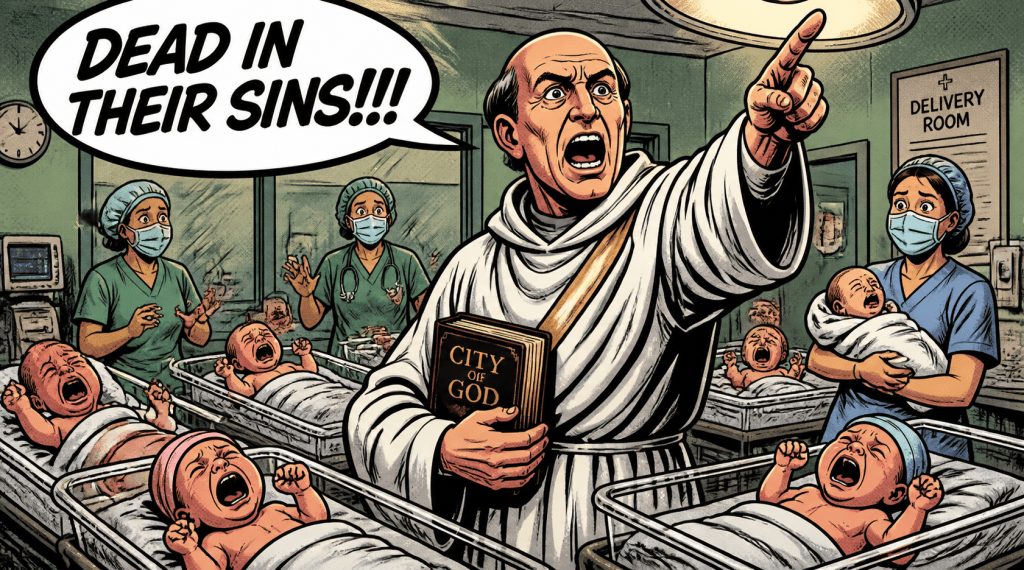
Augustine of Hippo did more than any other single writer to teach the West that a newborn arrives already on trial. In his telling, Adam’s first disobedience is not merely the door through which death entered the world. It is a verdict already rendered on every infant who has never chosen, never known the law, and never broken a commandment. The child is not only mortal. The child is guilty.

That idea still governs large parts of Catholic and Calvinist theology. It should not. The Bible does not teach that babies are evil, or that men are damned for Adam’s sin. It teaches that men are condemned for the sins they themselves commit.
The Augustinian claim is easy to summarize and hard to defend from the text. Because Adam fell, every person descending from him by ordinary generation inherits both corruption and guilt. The infant has committed no personal fault, yet stands in need of remission. Catholic teaching still says children are “born with a fallen human nature and tainted by original sin” and therefore need baptism to be freed from the power of darkness. The Council of Trent made the logic unmistakable: infants “who could not as yet in themselves commit any sin” are nevertheless baptized “for the remission of sins,” so that what they “contracted by generation may be cleansed away by regeneration.” Modern catechisms soften the pastoral tone and speak of hope for the unbaptized child. They do not surrender the premise. The stain is still said to be there before the child has done anything.
Reformed confessions are blunter. The Westminster Confession states that Adam and Eve, being “the root of all mankind,” passed on not only a corrupted nature but “the guilt of this sin,” imputed to all their posterity. Original sin, like actual sin, “bring[s] guilt upon the sinner,” binding him over to the wrath of God. A baby may be called relatively innocent in the civil sense. Before God, on this reading, he is already liable. Some later Calvinists insist that all who die in infancy are elect. That is a pastoral rescue of a doctrine that first placed the infant under wrath.
The King James Bible will not carry this weight.
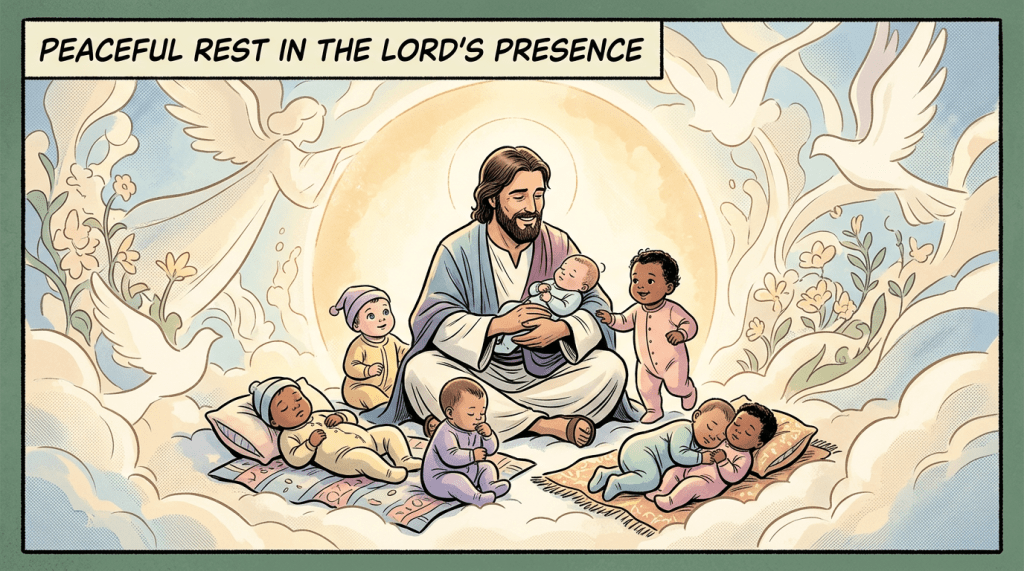
“The soul that sinneth, it shall die,” says Ezekiel. Then the prophet closes the door Augustine later forced open: “The son shall not bear the iniquity of the father, neither shall the father bear the iniquity of the son.” Deuteronomy is just as plain: “Every man shall be put to death for his own sin.” Jeremiah repeats the same rule. These are not side remarks. They are God’s own correction of a proverb that blamed children for the fathers’ sour grapes.
Sin, in Scripture, is not a vapor inherited at conception. “Sin is the transgression of the law.” Where there is no law, “there is no transgression,” and “sin is not imputed.” A child who has “no knowledge between good and evil” is treated in Deuteronomy as distinct from the adults who rebelled. Jesus did not look at little children and say they were vipers awaiting baptism or secret election. He said, “of such is the kingdom of heaven,” and told grown men they must become as little children to enter it. When Israel shed the blood of sacrificed children, the text calls that blood innocent. David, after the death of his infant son, said he would go to the child. He was not describing reunion in a courtroom of inherited guilt.
Romans 5 is the passage always pressed into Augustinian service. “By one man sin entered into the world, and death by sin; and so death passed upon all men, for that all have sinned.” Yes. Death passed upon all. The creation was subjected to mortality. The race was wounded. Paul immediately notes that death reigned even over those who had “not sinned after the similitude of Adam’s transgression.” That is an argument for the reach of death, not a license to charge a newborn with Adam’s specific iniquity. “All have sinned” in the rest of Romans is not a metaphysical claim that infants sinned in the garden before they existed. It is the apostle’s indictment of the world that actually practices unrighteousness. Psalm 51:5 is David’s broken confession of his own adultery and bloodguilt, not a legal theory that every infant is already condemned. Ephesians 2 describes people who walked in trespasses and were by nature children of wrath. It does not rewrite Ezekiel.

Augustine needed inherited guilt to make infant baptism necessary for the remission of a sin the infant had not committed. Calvin needed it to make total inability and federal imputation airtight from the womb. Both systems solve a problem the apostles never posed. The New Testament never commands the baptism of infants. It never says an unbaptized baby is excluded from the kingdom because of Adam. It never tells grieving parents that their dead child was “bound over to the wrath of God” unless quietly numbered among the elect. Those are the inventions of later rooms: Hippo, Trent, Westminster.
The moral cost of the invention is not small. If a baby is already guilty, then innocence is a sentiment and personal responsibility is secondary. If humans are evil from birth in the forensic sense, then the first fact about a child is not that he is made in the image of God and has not yet transgressed. The first fact is a debt he did not contract. Scripture will not have it. Men become guilty when they sin. They die physically because Adam opened the door of death. They are judged for “the things done in [the] body.” The son does not bear the father’s iniquity.
A serious reading of the Bible can admit the Fall without turning the nursery into a dock. We inherit weakness, mortality, and a world already bent. We do not inherit Adam’s courtroom verdict. That verdict is his. Ours arrives later, when we know to refuse the evil and choose the good, and choose the evil anyway.

The older doctrine survives because it is systematic, not because it is scriptural. It flatters the need for a single theory that explains baptism, depravity, and infant death in one stroke. The text is less tidy and more just. All have sinned. That is why adults need mercy. A baby has not. That is why Jesus could take children in his arms without first explaining that they were guilty of a theft in Eden.
Augustine taught the West to see a convict in the cradle. The Bible teaches us to see a soul that has not yet sinned. The difference is not a nicety. It is the difference between a God who judges men for their own deeds and a system that condemns them for another man’s.


Leave a Reply