
America has learned to speak of Hinduism the way a museum speaks of marble: as heritage, as color, as a generous alternative to the narrowness of the West. City parks fill with Diwali lamps. Yoga studios borrow the names of postures that were once acts of devotion. Publishers describe a “family of faiths” in which every deity is a facet of the same light. The implied bargain is simple. Call it culture and you need not call it theology.

The Bible does not accept the bargain.
That sentence will sound rude in a country trained to treat all religions as equal accessories of identity. It is, nevertheless, the only sentence available if the Scriptures are allowed to mean what they say. The Bible does not describe the gods of the nations as misunderstood cousins of the God who made the heavens. It describes them as idols. And it describes the worship offered to them as worship offered to devils.
This is not a late Protestant mood. It is the plain grain of the text.
“For all the gods of the nations are idols: but the LORD made the heavens.” That is Psalm 96:5. Deuteronomy is blunter still: “They sacrificed unto devils, not to God; to gods whom they knew not, to new gods that came newly up.” Paul, writing to Gentiles who knew their way around a temple kitchen, refuses the polite distinction between empty wood and a living power. “What say I then? that the idol is any thing, or that which is offered in sacrifice to idols is any thing? But I say, that the things which the Gentiles sacrifice, they sacrifice to devils, and not to God.”
An idol, in other words, is nothing as carpentry. It is not nothing as liturgy. The statue cannot see. The spirit that consents to be fed through the statue is another matter.
Hinduism, judged by that standard, is not a cousin of biblical faith wearing brighter clothes. It is the most elaborate living system of the thing the prophets spent their lives forbidding: many named gods, many images, many altars, and a public claim that these beings create, preserve, destroy, marry, beget, and save.
The stories are not incidental
The usual defense is that the stories are poetry. Brahma rising from a lotus in Vishnu’s navel, Shiva as a pillar of fire, Kali leaping from a goddess’s darkened brow to drink blood so that a demon cannot multiply from the drops — these, we are told, are symbols of consciousness, time, and the maternal absolute. Read them as metaphysics and the offense dissolves.
Read them as the Bible trains a reader to read pagan narrative and the offense sharpens. The stories are not a later embarrassment. They are the religion’s account of where its gods came from.
Brahma does not speak worlds into being from nothing. He hatches from a golden egg, or climbs out of another god’s body, or is himself generated by a goddess, depending on which Purana is telling the tale. He creates gods, demons, and men from mind and limb, grows proud, and in one tradition loses a head to Shiva. A creator who is born, demoted, and mutilated is not the God of Genesis 1. He is a claimant. Isaiah’s answer to all such claimants is short: “Before me there was no God formed, neither shall there be after me.”
Vishnu sleeps on an endless serpent in a cosmic ocean and wakes to emit worlds. He then descends, again and again, as fish, tortoise, boar, man-lion, dwarf, warrior, and cowherd. The tradition calls this compassion. Deuteronomy 4 calls the making of God in the likeness of fish, beast, and mixed flesh a corruption. Romans 1 is more clinical. Men “changed the glory of the uncorruptible God into an image made like to corruptible man, and to birds, and fourfooted beasts, and creeping things.” Then, Paul says, God gave them up.
A god whose highest throne is a serpent is already sitting in the wrong chair. Genesis 3 and Revelation 12 do not treat the serpent as furniture. They treat it as the old adversary, Satan.
Shiva is the destroyer who wears serpents, haunts the ground of the dead, and is worshiped in the linga, a stone of sexual form. He beheads the boy Ganesha in a rage and repairs the murder by grafting on an elephant’s head, after which the composite is declared the first god to be honored. The tale is told in India with affection. The second commandment is not affectionate toward it. A deity assembled from clay, homicide, and the head of a beast is not a mysterious face of the Holy One. It is the imagination of Romans 1 working in public.
Krishna’s birth story is the one that should stop a biblical reader cold. A god enters a human womb, appears first in four-armed glory, shrinks into an infant, is smuggled across a river, grows up among cattle, takes many wives, slays enemies, and is remembered as a man of renown. In some tellings Vishnu pulls a black hair from his body and sends it into a woman to become the child.
Genesis 6 is only four verses, but they are enough. “The sons of God saw the daughters of men that they were fair; and they took them wives of all which they chose… and they bare children to them, the same became mighty men which were of old, men of renown.” The New Testament returns to that breach. Jude speaks of angels who “kept not their first estate, but left their own habitation,” and sets the crime beside “strange flesh.” Second Peter ties the angels that sinned to the world Noah preached to.
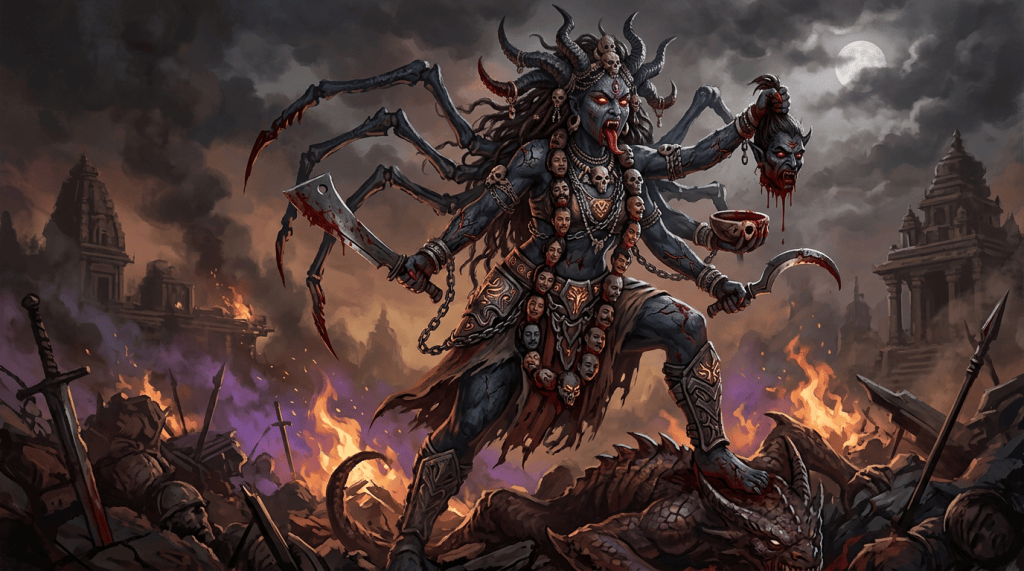
The Bible does not write Krishna’s name into Genesis. It does describe the pattern of which Krishna is the polished Indian instance: a heavenly being who wants a woman’s body, a hero’s fame, and a god’s altar.
Indra, the Vedic storm-king, drinks the sacrificial intoxicant, throws the thunderbolt, slays the serpent Vritra, fathers human heroes, and is later reduced to a nervous tenant of heaven who must be rescued by greater gods. He is Zeus with a Sanskrit passport. Psalm 96 already had him in view: the gods of the nations are idols.
Kali is born of wrath. She wears skulls. She laps blood. She almost pulls the world down until another god lies down under her feet. Devotees will say this is the fierce mother who destroys illusion. The Hebrew Scriptures have a category for gods served in blood and terror. It is not “the hidden side of Yahweh.” It is abomination.
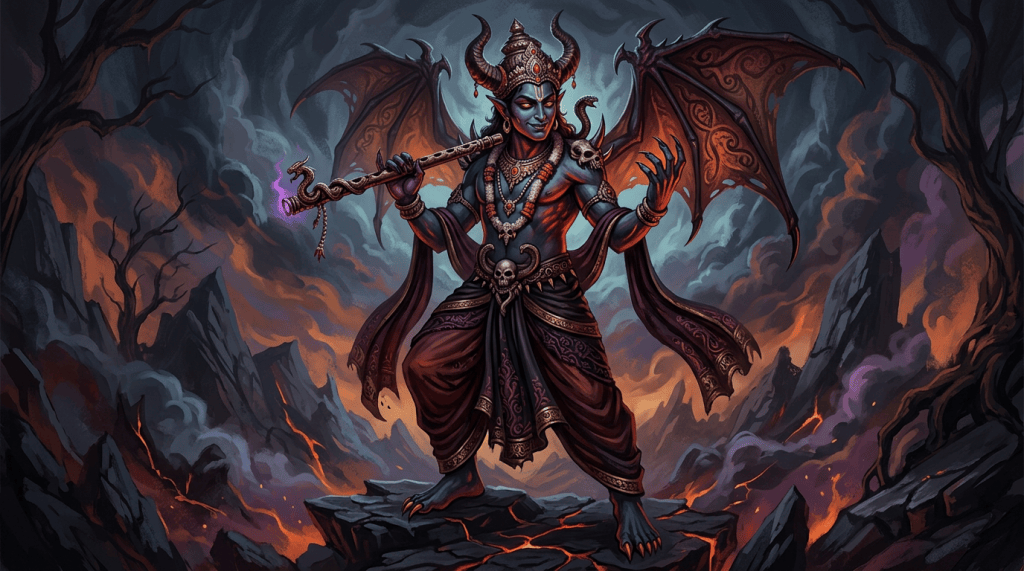
None of this requires a conspiracy chart in which every Hindu name is a particular chained angel from Second Peter. Those angels, the text says, are already bound. The spirits Paul has in mind in Corinth are not bound. They receive Gentile sacrifice now. The honest biblical sentence is therefore not “Shiva is Semjaza.” It is this: the origin stories of the Hindu gods are stories of beings who are born, who lust, who teach war and mantra, who take flesh and animal flesh, who demand food and flowers and sometimes blood, and who will not endure a rival claim that there is one Lord and no other. That is the résumé of a devil in the only sense the Bible uses the word when it talks about the nations’ gods.
The older Jewish expansion only makes the rhyme louder
The Book of Enoch is not biblical canon. It is the Second Temple expansion of Genesis 6, and it should be handled as such. What it adds is a curriculum. Two hundred Watchers descend, swear an oath on a mountain, take wives, and sire giants who devour men and drink blood. Azazel teaches swords, armor, metals, jewelry, and the painting of the eyes. Others teach root-cutting, counter-spells, and the reading of the stars. When the giants’ bodies die, their spirits remain on the earth to afflict the living.

Hindu myth does not quote that book. It keeps humming the same tune in a different key. Gods and apsaras take human lovers and leave lines of half-divine kings. Rakshasas eat men and change shape. Divine weapons are not invented by farmers; they are handed down from above. Herbs and mantras arrive as revelation. Astrology is a sacred science. A serpent and a mountain are used to churn a nectar of immortality out of the sea. A flood survives in the story of Manu and the fish. The leftover beings of violent and incomplete death wander as bhutas and pretas.
Enoch files the pattern under crime. The Puranas file it under worship. That reversal is the whole argument. The content of the stories is not alien to the Bible’s world. The moral of the stories is.
What a modern nation does with this
India is not a metaphor. It is the largest Hindu country on earth, a nuclear power, a software power, a civilization of staggering intellect. Wrath, in Scripture, is not the absence of airports. The wrath already revealed from heaven, Paul says, is that God gives a culture up to the lie it prefers.
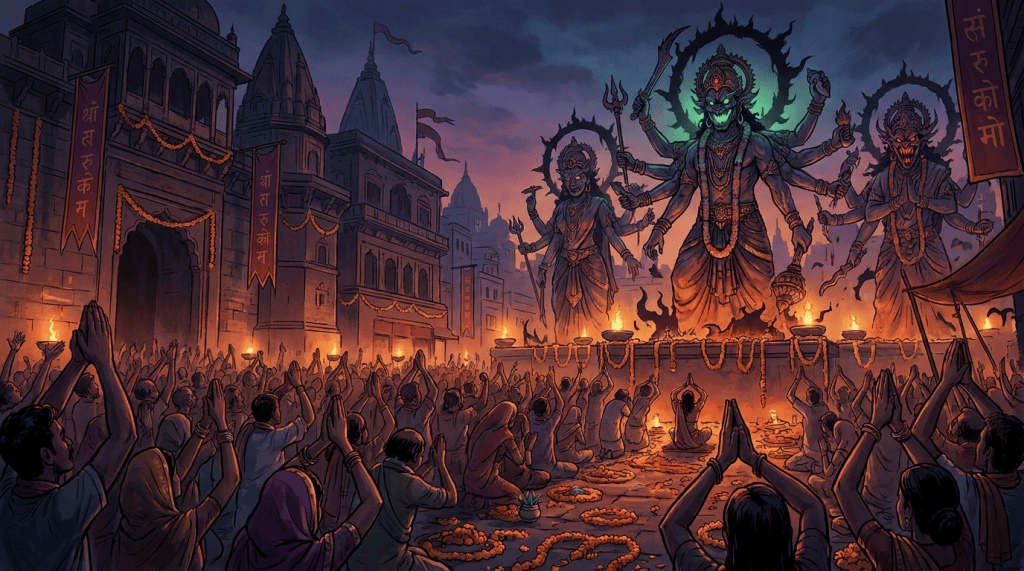
The lie is still preferred in public. Images are not a minority taste. Caste, however illegal in a statute book, remains a religious grading of bodies that the apostles would have recognized as respect of persons raised to a cosmology. Remnants of dedicating girls to a deity — the old temple traffic in flesh — survive the bans written against them. In more than a dozen states, conversion to Christ can be policed as “allurement,” a word elastic enough to cover charity, a school, or a husband and wife baptized on the same afternoon. Return to the ancestral gods is often treated as restoration. That is not pluralism. That is a republic defending its altars.
None of this makes every Hindu a villain. The same book that calls the nations’ sacrifices devil-worship says that God “hath made of one blood all nations of men,” and that He “now commandeth all men every where to repent.” There is a church in India. It is often poor. It is often drawn from the people the old hierarchy called unclean. It is often struck. If there is a remnant in the biblical sense, it is there, not in the gift shop that sells Ganesha to American undergraduates as a lucky mascot.
The American habit is to call that remnant intolerant and the temple inclusive. The habit is a luxury. It is easy to be inclusive about gods you do not believe exist. The apostles believed they existed enough to refuse their table. “Ye cannot drink the cup of the Lord, and the cup of devils.”
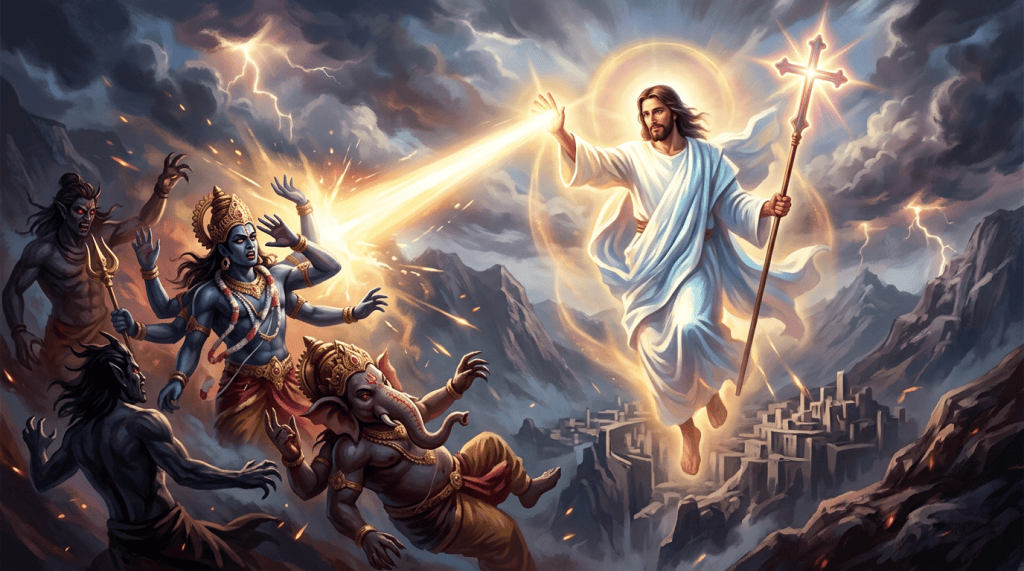
A serious reader of the Bible can still love India, still honor its languages and its courage, still pray for its poor and its persecuted. What he cannot do is call its pantheon a harmless poem. The poem has temples. The temples have offerings. The offerings are not for God, it is for the devils of the world.
Repent and believe.



Leave a Reply