
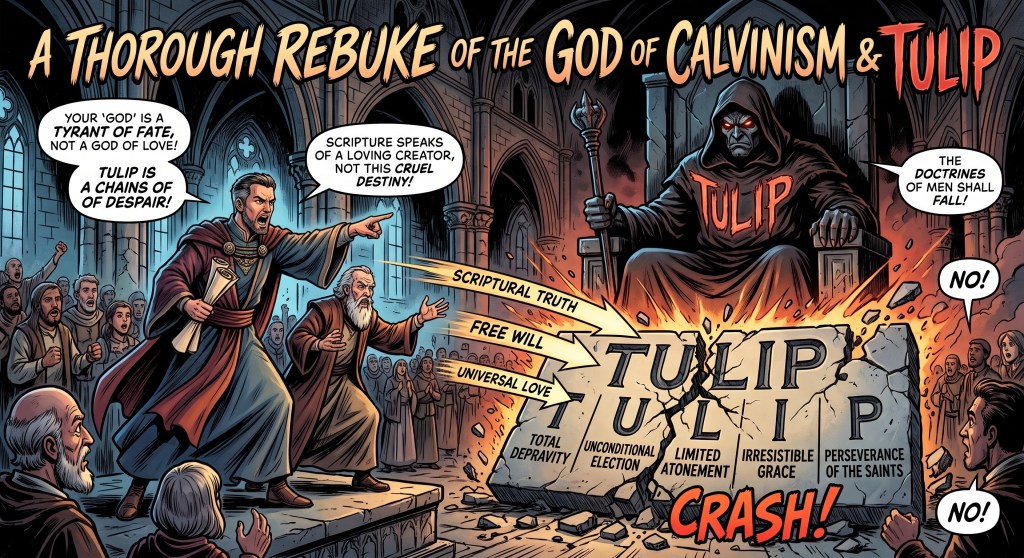
In the quiet corners of many evangelical churches today, a doctrine is preached with the confidence of ancient orthodoxy. It is called TULIP—Total Depravity, Unconditional Election, Limited Atonement, Irresistible Grace, and Perseverance of the Saints. Its defenders present it as the purest distillation of biblical truth, a fortress against the soft sentimentalism of modern Christianity.

Yet when measured against the plain wording of the Bible, TULIP stands exposed as a later human construction. It was systematized by John Calvin in the 16th century, drawing heavily from the speculative theology of Augustine of Hippo more than a thousand years earlier. What the system produces is not the God of Scripture but a character of its own making: a deity whose love is partial, whose invitation is not sincere, and whose decrees quietly override the very words He caused to be written.
The Bible does not hide its portrait of God. He is “not willing that any should perish, but that all should come to repentance” (2 Peter 3:9). He “will have all men to be saved, and to come unto the knowledge of the truth” (1 Timothy 2:4). He so loved “the world” that He gave His only begotten Son so that “whosoever believeth in him should not perish” (John 3:16). Christ “gave himself a ransom for all” (1 Timothy 2:6), is “the propitiation for our sins: and not for ours only, but also for the sins of the whole world” (1 John 2:2), and “tasted death for every man” (Hebrews 2:9). These are not obscure texts. They are central, repeated, and unambiguous.
TULIP survives only by treating them as half-truths that must be qualified, narrowed, or redefined until they fit a predetermined philosophical scheme.

Begin with Total Depravity. Scripture is clear that “there is none righteous, no, not one” and that “all have sinned” (Romans 3:10, 23). The natural man does not receive the things of the Spirit of God (1 Corinthians 2:14). Men are dead in trespasses and sins (Ephesians 2:1). These statements are true and necessary. Calvinism, however, pushes the language beyond the text. “Dead” is made to mean absolute inability even to respond to the gospel until God first regenerates the sinner by an irresistible act.
The system thereby renders the Bible’s own invitations incoherent. “Believe on the Lord Jesus Christ, and thou shalt be saved” (Acts 16:31). “Repent ye, and believe the gospel” (Mark 1:15). “Whosoever will, let him take the water of life freely” (Revelation 22:17). “Choose you this day whom ye will serve” (Joshua 24:15). If the unregenerate are constitutionally incapable of any response, then these commands are issued to people God has rendered unable to obey.
The resulting portrait is of a God who holds creatures accountable for an inability His own decree has imposed—a character foreign to the Scriptures.
Unconditional Election fares no better under scrutiny. The Bible speaks of God’s elect and of predestination. Election is real. Yet the system takes the language of national Israel—“beloved for the fathers’ sakes” (Romans 11:28)—and of those who are “in Christ” through faith (Ephesians 1:4; Galatians 3:7) and transforms it into an eternal, individual selection made without regard to any foreseen faith or response.

Romans 9 is pressed into service as a proof-text while the surrounding testimony of Scripture is subordinated. The God who declares that He is “no respecter of persons” (Acts 10:34) and who offers salvation to “whosoever shall call upon the name of the Lord” (Romans 10:13) is recast as one who, from eternity, fixed a limited number for life and passed over the rest. The open invitation of the gospel becomes, in practice, a theatrical performance directed only at those already chosen. The half-truth of divine sovereignty is elevated into a deterministic decree that empties the biblical calls of their sincerity.
Limited Atonement is the doctrine’s most transparent departure from the text. The New Testament repeatedly states that Christ died for all, for every man, for the whole world. Calvinism replies that “all” means “all kinds of men,” that “world” means “the world of the elect,” and that “every man” means every elect man. The ordinary sense of the words is discarded so that the atonement’s intent may be restricted to the predetermined few. The result is a Christ whose blood is deliberately insufficient for the non-elect—a Savior who does not, in fact, give Himself a ransom for all.
This is not a minor interpretive difference. It rewrites the character of the cross and the heart of God. The Jesus who wept over Jerusalem (Luke 19:41) and the Father who is not willing that any should perish are replaced by a deity whose love was never genuinely extended beyond a fixed roster.

Irresistible Grace completes the logic. The Spirit convicts and draws; that much is biblical. Yet the system asserts that the effectual call cannot be resisted by the elect and is never truly extended in a way that could succeed to the non-elect. Scripture records that men “always resist the Holy Ghost” (Acts 7:51) and that Jerusalem was unwilling when Christ would have gathered her children (Matthew 23:37). The repeated biblical imperatives to choose and believe presuppose the possibility of refusal.
Calvinism must treat these resistances as either illusory or applicable only to the reprobate. The God who calls becomes, for some, a force that cannot be withstood and, for others, a voice that was never sincerely addressed to them.
Perseverance of the Saints is often presented as the comforting assurance that true believers cannot be lost. Scripture does teach that those who are in Christ are kept by the power of God (1 Peter 1:5; John 10:28–29). Yet within the TULIP framework, perseverance is not the security of every person who believes; it is the inevitable outworking of an unconditional election.

The God who issues real warnings is made to speak words that, for the elect, can never carry real consequence. Taken together, the five points construct a coherent philosophical system in which God’s eternal decree determines every individual’s destiny prior to and apart from any human response. The universal language of the gospel is subordinated to that decree. The sincerity of the invitations is compromised. The reality of human resistance is minimized. The result is a character of God not found in the Scriptures: a deity whose revealed will (that all should be saved) is distinct from, and ultimately overridden by, a secret will that has already fixed the outcome.
Scripture nowhere requires such a dual-will construction. It presents one consistent God who holds men accountable for the response He commands and enables through the preached word and the convicting Spirit.
This is not a denial of divine sovereignty, of election, of the necessity of grace, or of the security of the believer. It is an insistence that the TULIP framework achieves its coherence only by selective emphasis and the redefinition of ordinary words. “All,” “world,” “whosoever,” “every man,” “draw,” and “elect” are pressed into the service of a system that Augustine began to shape and Calvin later systematized.
The apostles did not teach it. The plain text of the Bible does not require it. And the character of God that emerges from it—irresistibly determining some to life while leaving others without genuine provision or invitation—cannot be reconciled with the God who so loved the world, who tasted death for every man, and who is not willing that any should perish.

The danger is not merely intellectual. A system that restricts the cross, qualifies the love of God, and renders the gospel invitation less than sincere risks leading souls either to despair or to a false assurance rooted in a decree rather than in the finished work of Christ offered freely to all. The church does not need another layer of human systematizing. It needs the plain words of Scripture restored to their ordinary sense. Christ died for all. The call is to whosoever will. Faith cometh by hearing, and hearing by the word of God. The God of the Bible is not the God of TULIP. The difference is not a matter of emphasis. It is a matter of truth.




Leave a Reply