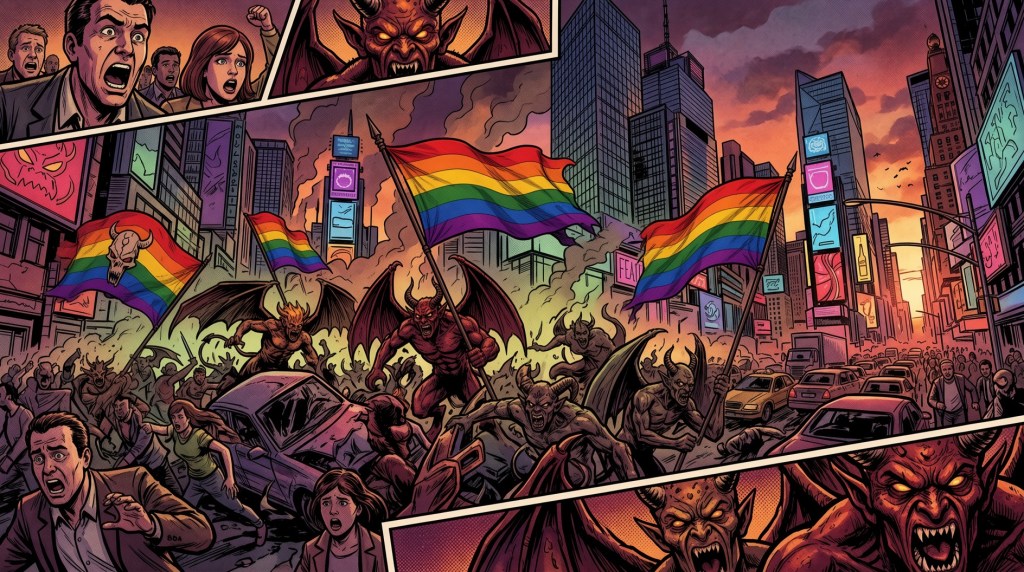
In the America of 2026, a single public profession has become the most reliable shorthand for moral respectability: enthusiastic support for the LGBTQ movement. Corporations fly the rainbow flag with more consistency than the Stars and Stripes. Universities treat dissent from gender ideology as a firing offense.

Politicians who once spoke of traditional marriage now compete to outdo one another in affirming every new iteration of identity. What was once recognized as a departure from the created order is now presented as the very measure of righteousness. Isaiah 5:20 names this phenomenon with precision: “Woe unto them that call evil good, and good evil; that put darkness for light, and light for darkness; that put bitter for sweet, and sweet for bitter.” Romans 1:32 completes the diagnosis: those who, “knowing the judgment of God, that they which commit such things are worthy of death, not only do the same, but have pleasure in them that do them.”
This is modern demonic morality—not the cartoonish theatricality of horror films, but the quieter, more effective inversion of categories that Scripture attributes to the spirit of antichrist. From its mythic origin at the Stonewall Inn in 1969 to its present institutional dominance, the movement has never been a neutral plea for private tolerance. It has been a sustained challenge to the authority of the Creator over the body, over sex, and over the meaning of the human person itself.
The founding narrative remains the first and most enduring lie. A police raid on an illegal, Mafia-operated bar that facilitated homosexual solicitation and unlicensed alcohol sales was transformed into a sacred “uprising” for dignity. The actual events—bricks, fires, multi-night disorder—were rewritten as the American equivalent of a civil-rights crucible. Once that romantic origin story was accepted, every subsequent demand could be framed as the logical extension of justice. Decriminalization of the acts themselves (Lawrence v. Texas, 2003) was presented as the end of persecution. Redefinition of marriage (Obergefell v. Hodges, 2015) was sold as the completion of equality. Each step further severed the legal order from the biblical pattern of Genesis 1:27 and 2:24—male and female, one man and one woman in lifelong covenant.

Hollywood supplied the catechism. Will & Grace made the lifestyle witty and companionable. Modern Family made same-sex parenting appear ordinary and even preferable. By the late 2010s the project had become industrial. GLAAD’s reports tracked and celebrated rising percentages of LGBTQ characters on broadcast television, then demanded still higher quotas—10 percent, then 20 percent in film, then 50 percent.
Networks that once aimed content at adults turned to children’s programming, embedding the ideology in cartoons and youth series so that the next generation would never know a world in which the behaviors were questioned. When Disney briefly hesitated to oppose a Florida law limiting classroom instruction on sexual orientation and gender identity for young children, the same advocacy apparatus expanded its scorecards to punish corporate silence, grading studios on political donations and public advocacy. Neutrality was redefined as complicity.
The result in 2026 is a moral order in which affirmation of the movement functions as the primary credential of goodness. To support it is to signal compassion, progress, and enlightenment. To withhold support—or worse, to speak the plain language of Scripture—is to mark oneself as hateful, backward, or dangerous. This is precisely the inversion Isaiah described. The acts that Leviticus calls abomination and that Paul lists among those who “shall not inherit the kingdom of God” (1 Corinthians 6:9-10) are now the standard by which a society measures its own virtue.

Romans 1:32 is no longer a distant warning; it is a description of the present hour. People do not merely practice the behaviors; they take public pleasure in those who do, and they demand that everyone else do the same.The antichrist character of the movement is visible from the beginning. The spirit of antichrist, according to 1 John 4:3, is already in the world and is known by its denial of Jesus Christ come in the flesh—its refusal of the authority of the incarnate Son over the whole of human life.
When a movement insists that the body is clay to be reshaped according to internal feeling, that marriage is a social construct rather than a divine ordinance, and that children may be chemically and surgically altered in the name of identity, it is not merely disagreeing with a traditional ethic. It is asserting that the Creator’s design is optional and that the self is sovereign. The slogan “my body, my choice,” applied to the rejection of biological sex, echoes the original “I will” of Isaiah 14:14.
The six-color flag that now flies over schools and city halls deliberately truncates the seven-color covenant bow of Genesis 9, a visual claim that human autonomy has superseded divine promise.
None of this requires conspiracy theories about secret cabals. It requires only the biblical understanding of spiritual warfare. Ephesians 6:12 reminds us that we wrestle not against flesh and blood, but against principalities and powers. The same spirit that filled the streets of Sodom, that staffed the temples of Ashtaroth with gender-inverting priests, and that demanded children for Molech has simply found new institutions through which to operate.

The Stonewall myth provided the sentimental cover. The courts provided the coercive power. The entertainment industry provided the daily formation of conscience. Together they have produced a culture in which the refusal to celebrate what God condemns is treated as the only remaining unforgivable sin.
Yet the gospel remains. The same Apostle who catalogued the behaviors also wrote, “And such were some of you: but ye are washed, but ye are sanctified, but ye are justified in the name of the Lord Jesus, and by the Spirit of our God” (1 Corinthians 6:11). Individuals can still turn. Churches can still speak. Parents can still protect. The woe of Isaiah 5:20 and the judgment of Romans 1:32 are real, but they are not the final word for those who repent.
The question for a nation that has made affirmation of abomination its badge of righteousness is whether any still possess the clarity—and the courage—to call the inversion by its true name before the darkness is complete.


Leave a Reply