
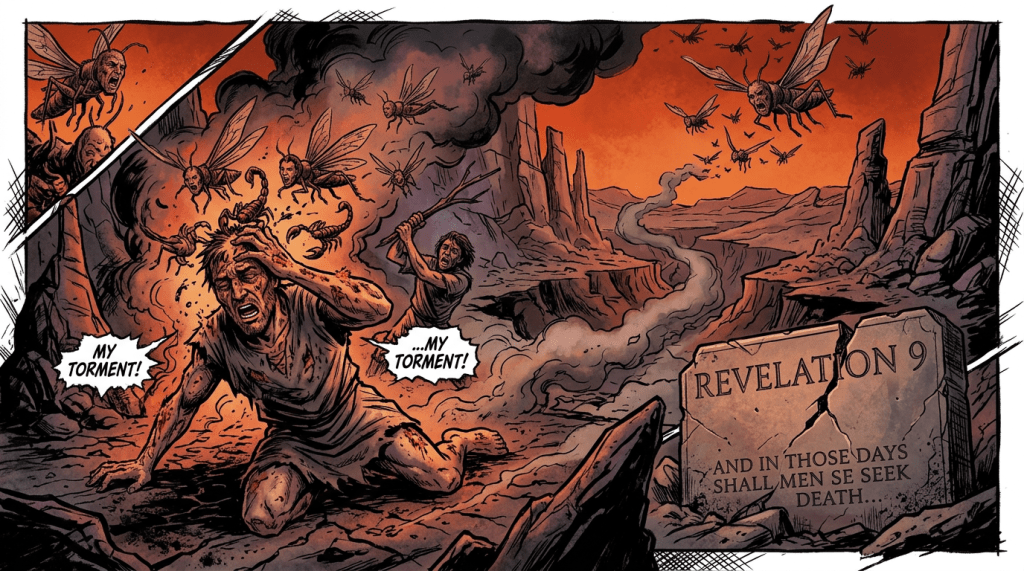
In the ninth chapter of the Book of Revelation, according to the King James Version, a sequence of divine judgments unfolds as God releasing a temporary manifestation of hell upon unbelievers before advancing to lethal consequences for those who refuse to turn away from their ways.

The chapter begins with the sounding of the fifth trumpet. A star fallen from heaven is given the key to the bottomless pit and opens it. Smoke rises “as the smoke of a great furnace,” darkening the sun and the air. From the smoke emerge locust-like creatures granted power “as the scorpions of the earth.” These beings are commanded not to harm vegetation but only “those men which have not the seal of God in their foreheads.” For five months they inflict torment “as the torment of a scorpion, when he striketh a man,” so severe that “men seek death, and shall not find it; and shall desire to die, and death shall flee from them.”
The creatures are portrayed with distinctive features: shapes like horses prepared for battle, crowns resembling gold, faces as of men, hair as of women, teeth as of lions, iron breastplates, wings sounding like chariots of many horses, and tails like scorpions with stings. Over them rules “the angel of the bottomless pit,” named Abaddon in Hebrew and Apollyon in Greek.
Scripture elsewhere associates the bottomless pit, or abyss, with the confinement of demonic powers. Demons once begged not to be sent there, and the same pit later holds Satan for a thousand years. In the Old Testament, Abaddon appears in parallel with Sheol, the realm of the dead and destruction. Under a strictly literal reading, the fifth trumpet therefore presents the release of tormenting beings from this realm upon the unsealed—those without God’s mark—as a limited, earthly experience of the character of that place. Death itself is withheld, creating a period of undodgeable suffering that confronts the living with the reality of the pit.

The text records no repentance following this judgment. The narrative then advances to the sixth trumpet. A voice from the four horns of the golden altar before God orders the loosing of “the four angels which are bound in the great river Euphrates.” These angels, prepared for a specific hour, day, month and year, are released “for to slay the third part of men.”
An army of horsemen numbering two hundred thousand thousand follows, with horses whose heads resemble lions and from whose mouths issue fire, smoke and brimstone. By these the third part of humanity is killed. Their power resides also in tails like serpents that have heads.
The remaining survivors, the text states, “yet repented not of the works of their hands, that they should not worship devils, and idols of gold, and silver, and brass, and stone, and of wood.” They likewise continued in murders, sorceries, fornication and thefts.
In the progression from the fifth trumpet’s non-lethal torment to the sixth’s mass killing, the unrepentant are removed from further earthly opportunity. According to the broader witness of the same book, the unrighteous dead enter Hades, the intermediate state, until the great white throne judgment, after which death and Hades are cast into the lake of fire. The killing of one-third of remaining humanity thus transfers those who have already rejected the preceding warning into that intermediate condition.

The sealed are explicitly protected throughout. The judgments proceed under divine command, originating from the altar associated with the prayers of the saints. The limited duration of the fifth trumpet’s torment and the precise timing of the sixth underscore restraint even as the consequences intensify for those who persist without repentance.
Revelation 9 presents a controlled disclosure of the bottomless pit’s reality as a final warning to the living unsealed, followed by the release of previously bound angels whose actions consign a third of remaining humanity to the intermediate state of torment that precedes final judgment.


Leave a Reply