

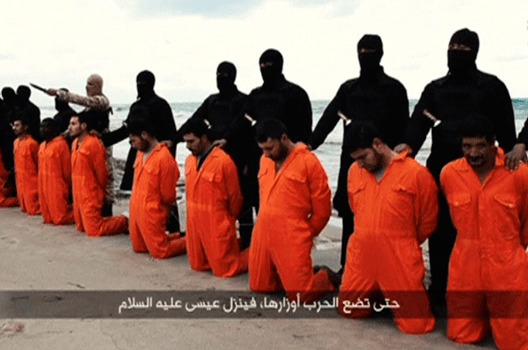
In the Book of Revelation, the Apostle John records a vision that has unsettled readers for nearly two millennia: “And I saw the souls of them that were beheaded for the witness of Jesus, and for the word of God, and which had not worshipped the beast, neither his image, neither had received his mark upon their foreheads, or in their hands.” That single verse—Revelation 20:4—describes the fate of faithful Christians during the final seven-year period of divine judgment known as the Tribulation. The method is specific. Not crucifixion. Not burning. Beheading.

A growing body of historical, theological, and eschatological evidence suggests that the agents of that beheading will not be some abstract totalitarian regime of the future, but the followers of a system already familiar to the world: Islam, acting under the authority of its long-awaited messianic figure, the Mahdi—the Antichrist of biblical prophecy.
This is not an exercise in bigotry. It is an exercise in taking the King James Bible at its word and measuring post-biblical history against the warnings Scripture issued first. When the Bible is treated as the final standard of truth, the patterns become difficult to dismiss.
Begin with the spirit of the age that Scripture itself identifies as antichrist. “Who is a liar but he that denieth that Jesus is the Christ? He is antichrist, that denieth the Father and the Son” (1 John 2:22). Islam’s foundational texts do precisely that. The Quran insists Jesus was neither crucified nor divine. He is reduced to a prophet who will return not as the victorious Lamb of God but as a subordinate who breaks the cross and enforces Islamic law. That denial is not peripheral; it is definitional. Any system that permanently enshrines it stands under the biblical description of the spirit of antichrist.

Islamic tradition then supplies the personal embodiment of that spirit. The Mahdi is expected to rise amid chaos, unite the Muslim world under a caliphate, conquer Jerusalem, and rule for seven to nine years—precisely the timeframe of Daniel’s seventieth week and the Tribulation of Revelation. He is accompanied by an Islamic “Isa,” a counterfeit Jesus who prays behind the Mahdi and abolishes Christianity. Scripture’s two beasts—one from the sea, one from the earth—map onto this dual figure with unsettling precision. The Mahdi receives global authority; the Islamic Isa enforces worship of the system and its image.
That image, too, has a candidate. The Kaaba and its Black Stone have been objects of global veneration for centuries. Islamic hadiths themselves declare that the Stone will one day speak and testify. Revelation 13 describes an image given power to speak and to compel worship on pain of death. The parallel is formal, not forced.
The mark that seals loyalty to this system is equally concrete in Islamic eschatology. The Dabbat al-Ard—the Beast of the Earth—emerges from the ground, speaks to humanity, and brands every face: luminous for those who submit, blackened for those who refuse. After its appearance, repentance is said to be impossible. Revelation 13 describes a second beast rising from the earth that causes all to receive a mark in the right hand or forehead, without which no one may buy or sell.

The functional identity is striking. Those who receive the Islamic “light” under the Mahdi’s rule receive, in biblical terms, the mark of damnation. Those who refuse become the company described in Revelation 20:4.
History has already previewed the enforcement method. On August 14, 1480, after Ottoman forces seized the Italian city of Otranto, some 800 Christian men were offered a simple choice: convert to Islam or die. They refused. Led by a tailor named Antonio Primaldo, they were marched to a hill outside the city and systematically beheaded. Their bones remain visible today in the Cathedral of Otranto. The archbishop was sawn in half while still in his vestments. The cry that accompanied the slaughter was the same cry that has accompanied countless later acts of jihadist violence: Allahu akbar.
This was not an aberration. From the earliest Islamic conquests through the Ottoman centuries and into the present, beheading has been a preferred method for dealing with those who refuse submission. Scripture predicted the method centuries before the first Muslim army ever raised a sword. When a religious-political system repeatedly employs the exact form of execution the Bible associates with the final persecution of the saints, the correspondence demands attention.

The political structure that will give the Mahdi global reach is already visible in outline. Daniel and Revelation describe ten kings who yield their power to the beast for a brief period. A confederacy centered on a revived Syrian power—the biblical “king of the north”—drawing in Iraq, Turkey, Iran, Egypt, Libya, Sudan, Lebanon, Jordan, and the Arabian Peninsula fits both the geographic indicators of the prophets and the expansionist expectations of Islamic tradition. Recent realignments in the region after the fall of long-standing regimes only accelerate the sense that the iron-and-clay toes of Daniel’s statue are beginning to take shape.
None of this requires inventing new revelation. The Bible warned of a final system that denies the Son, demands worship of a speaking image, brands its adherents, and kills those who refuse—specifically by beheading. Islamic texts and history supply a comprehensive counterpart: a messianic figure who denies the biblical Christ, a speaking object of veneration, a beast that brands faces, a political vision of ten kingdoms under a caliphate, and a centuries-long practice of beheading those who will not abandon the witness of Jesus.
During the seven-year Tribulation, that system will move from shadow to substance. The Mahdi will rise. The mark will be enforced. And those who hold the testimony of Jesus and refuse to worship the beast will face the sword—not as a metaphor, but as the literal fulfillment of Revelation 20:4.
The same hand that has beheaded Christians for refusing to renounce Christ in the past will do so again, this time on a global scale and under the explicit authority of the Antichrist.
The pre-tribulation removal of the church, promised in 1 Thessalonians 4, will spare true believers from that hour. For those who remain, the choice will be stark: receive the mark and live under the Mahdi’s order, or refuse and join the company of the beheaded who reign with Christ.
Scripture does not name the year or the precise political borders. It does name the method, the loyalty test, and the spiritual character of the system that will enforce it. When later history produces a religion that matches those specifications more closely than any other, intellectual honesty requires that we notice. The Tribulation will not invent the pattern. It will perfect it.
The question is no longer whether such a persecution is conceivable. History has already answered that. The only remaining question is whether we will recognize the system Scripture described long before it reaches its final form.



Leave a Reply