
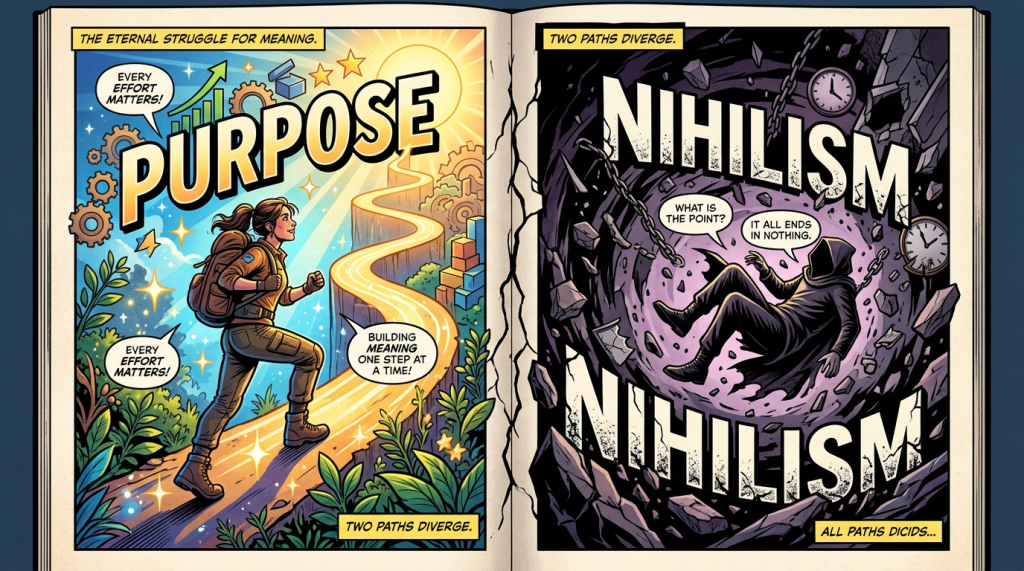
In the modern marketplace of ideas, few philosophies have proven more corrosive to the human spirit than nihilism and its close cousin, absurdism. Nihilism declares that existence is devoid of objective meaning, purpose, or intrinsic value. Life is a cosmic accident, morality a convenient fiction, and any search for significance a self-deception.

Absurdism, as popularized by thinkers who stare into the void and shrug, concedes the same pointlessness yet urges us to rebel against it with defiant, meaningless labor—like the mythical Sisyphus forever pushing his boulder uphill, finding a bitter contentment in the futility itself. Both systems leave the soul stranded in a universe that neither cares nor commands.
The Bible rebukes these teachings at every turn. Scripture does not whisper suggestions of meaning; it declares, with the authority of the Creator Himself, that life is ordered, purposeful, and accountable to an eternal God.
Begin at the beginning, for the Bible does. “In the beginning God created the heaven and the earth” (Genesis 1:1). This is not poetry to be demythologized or metaphor to be dismissed. It is the foundational assertion that the cosmos is the deliberate work of a personal, infinite Intelligence. Six times in the first chapter the text records that “God saw that it was good.” The material world is not a random collision of particles; it is pronounced good by its Maker.
On the sixth day, God forms man: “So God created man in his own image, in the image of God created he him; male and female created he them” (Genesis 1:27). Human beings are not accidental byproducts of blind evolutionary processes. They bear the imprint of the divine. Dominion is conferred—“Be fruitful, and multiply, and replenish the earth, and subdue it” (Genesis 1:28)—not as a license for exploitation, but as a stewardship that assumes responsibility and design.

Nihilism’s claim that we are “thrown” into existence without essence is contradicted by the plain statement that we are fashioned with essence: the image of God.
The Fall does not erase purpose; it explains the fracture we feel. When Adam and Eve disobeyed, death entered, and the ground was cursed (Genesis 3). Labor became toil, relationships strained, and the human heart inclined toward evil. Yet even in judgment the text preserves hope: the seed of the woman shall bruise the serpent’s head (Genesis 3:15). History is not a closed loop of meaninglessness; it is a narrative with a beginning, a crisis, and a promised resolution. Absurdism treats the tension between our hunger for meaning and the apparent silence of the universe as an unresolvable contradiction to be embraced. Scripture treats that tension as the consequence of sin and the invitation to redemption.
Ecclesiastes is often conscripted by nihilists who quote its opening cry—“Vanity of vanities, saith the Preacher, vanity of vanities; all is vanity” (Ecclesiastes 1:2)—and stop there. The Preacher surveys every earthly pursuit under the sun—wisdom, pleasure, labor, wealth—and finds them insufficient when severed from God. Yet the book does not end in despair. Its conclusion is unambiguous: “Let us hear the conclusion of the whole matter: Fear God, and keep his commandments: for this is the whole duty of man. For God shall bring every work into judgment, with every secret thing, whether it be good, or whether it be evil” (Ecclesiastes 12:13-14).
The vanity is real when life is lived horizontally, confined to the span between birth and death. It evaporates when the vertical dimension—accountability to the Creator—is restored. Nihilism absolutizes the horizontal and calls it wisdom. The Bible names it folly. The New Testament intensifies the rebuke. Jesus Christ does not offer coping mechanisms for an absurd existence; He claims to be the meaning itself. “I am the way, the truth, and the life: no man cometh unto the Father, but by me” (John 14:6). “I am come that they might have life, and that they might have it more abundantly” (John 10:10).

These are not therapeutic metaphors. They are exclusive, ontological claims. The cross is not a symbol of noble failure; it is the place where the Son of God “bare our sins in his own body on the tree” (1 Peter 2:24), purchasing reconciliation. The resurrection is not a mythic consolation; it is the historical vindication that death does not have the final word. “If in this life only we have hope in Christ, we are of all men most miserable. But now is Christ risen from the dead, and become the firstfruits of them that slept” (1 Corinthians 15:19-20). Nihilism’s final argument is the grave. The Bible’s final answer is an empty tomb.
Absurdism’s counsel to find happiness in the struggle itself collapses under scriptural scrutiny. The apostle Paul, who suffered shipwrecks, beatings, and imprisonment, does not urge stoic acceptance of futility. He writes, “For I reckon that the sufferings of this present time are not worthy to be compared with the glory which shall be revealed in us” (Romans 8:18). Labor is not an end in itself; it is performed “as to the Lord, and not unto men” (Colossians 3:23). Even the most ordinary tasks acquire eternal weight when done in obedience. Sisyphus has no such horizon.
His boulder rolls back forever because there is no Judge, no reward, no telos. The Christian’s work, by contrast, is remembered: “For God is not unrighteous to forget your work and labour of love” (Hebrews 6:10).Nihilism’s moral vacuum is equally exposed. If there is no objective good, then the commandments are preferences. Yet the King James text presents the moral law as the transcript of God’s character. “Thou shalt love the Lord thy God with all thy heart, and with all thy soul, and with all thy mind. This is the first and great commandment. And the second is like unto it, Thou shalt love thy neighbour as thyself” (Matthew 22:37-39).

These are not social constructs evolving with cultural fashion. They are the Creator’s design for human flourishing. The Ten Commandments, given at Sinai and reaffirmed by Christ, assume that right and wrong exist independently of human opinion. To deny this is not intellectual sophistication; it is rebellion against the One who “shall judge the world in righteousness” (Psalm 9:8).The practical fruits of these philosophies confirm the biblical diagnosis. Where meaning is denied, despair multiplies. Rates of anxiety, self-harm, and purposelessness rise in cultures that catechize the young in cosmic indifference. The Bible diagnoses the condition accurately: “The heart is deceitful above all things, and desperately wicked: who can know it?” (Jeremiah 17:9). It also provides the cure: repentance and faith. “Believe on the Lord Jesus Christ, and thou shalt be saved” (Acts 16:31). This is not escapism. It is the restoration of the creature to the Creator, the recovery of the image marred by sin, the anchoring of temporal life in eternal reality.
Some will object that a literal reading of an ancient text cannot address twenty-first-century disillusionment. The objection inverts the proper order. The text does not need updating; the age needs the text. The same God who formed the heavens continues to uphold them by the word of His power (Hebrews 1:3). The same Christ who walked the roads of Galilee is “the same yesterday, and to day, and for ever” (Hebrews 13:8). Human nature has not evolved past the need for purpose any more than it has evolved past the reality of death. Nihilism and absurdism are sophisticated ways of saying what the fool has always said in his heart: “There is no God” (Psalm 14:1).
Scripture answers the fool not with clever dialectic but with revelation. The choice before every reader is therefore stark. One may accept the counsel of the void and construct private meanings that dissolve at the first serious suffering or at the moment of death. Or one may receive the testimony of the Bible: that God is, that He has spoken, that He has acted in history through the incarnation, death, and resurrection of His Son, and that every human life is therefore summoned to fear Him, keep His commandments, and find its duty and its joy therein. Meaning is not invented; it is discovered in the fear of the Lord, which is the beginning of wisdom (Proverbs 9:10).

The boulder need not roll forever. The stone has already been rolled away from the tomb. Life, under the sovereignty of the living God, is neither nihilistic nor absurd. It is purposeful, accountable, and, for those who trust the word of the Lord, everlasting.
Don’t forget to Subscribe for Updates. Also, Follow Us at Society-Reviews, YouTube, Instagram, Twitter, Odysee, Rumble, and Twitch



Leave a Reply