
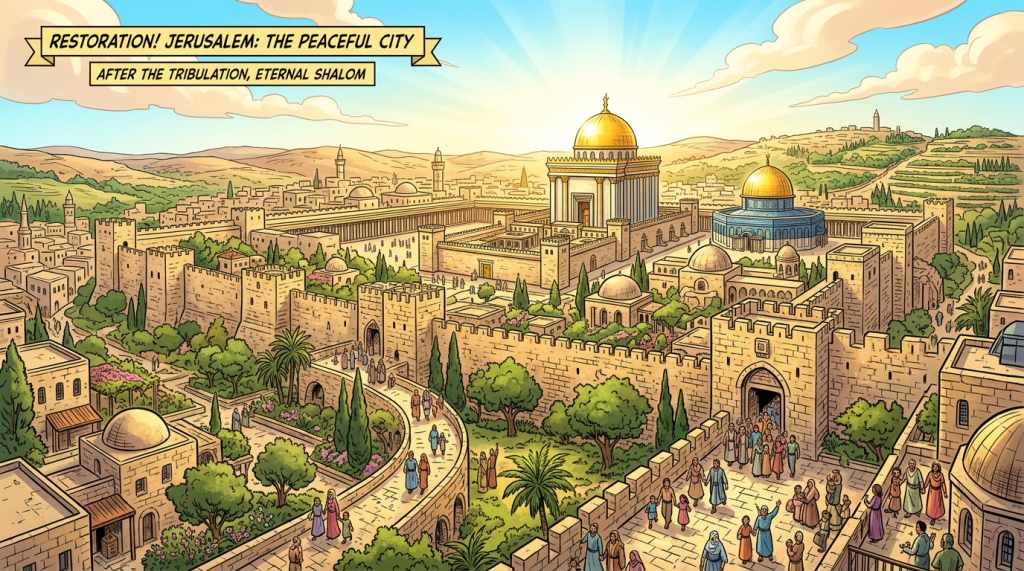
When the great distress ends and the King returns in glory, the world does not simply resume. Scripture describes a decisive separation, a restored order, and a thousand-year reign in which Christ rules from Jerusalem over a earth populated only by the righteous who survive judgment. The church—those believers, Jew and Gentile, already caught up to meet the Lord in the air before the tribulation—returns with Him. They do not re-enter ordinary life as mortals. They reign.

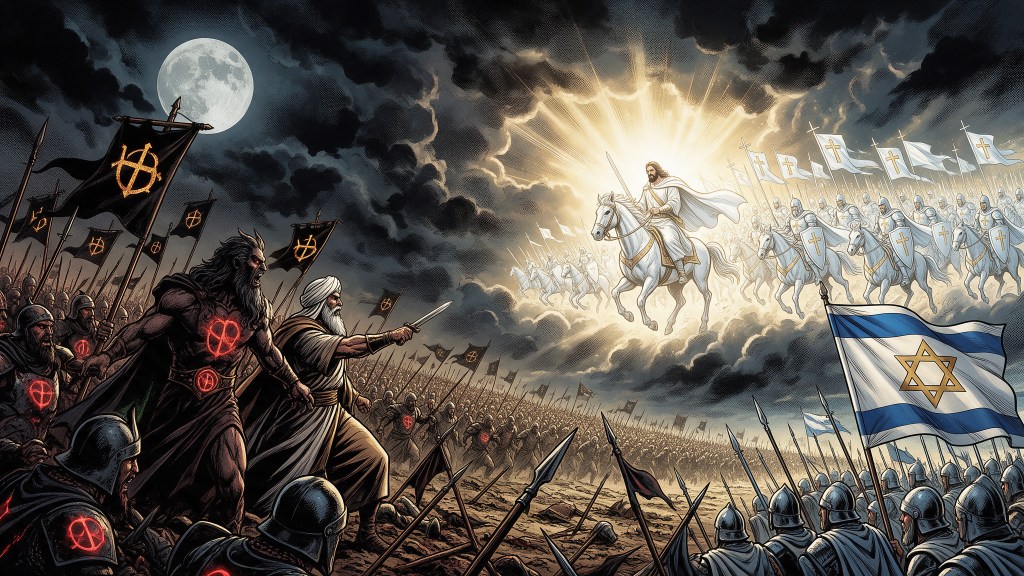
The sequence is plain in the text. The Lord descends with a shout; the dead in Christ rise first; those alive and remaining are caught up together with them in the clouds to meet the Lord in the air, and so shall they ever be with the Lord (1 Thessalonians 4:16-17). Later they appear with Him as the armies of heaven, clothed in fine linen, white and clean (Revelation 19:14). At His coming He sits upon the throne of His glory. All nations are gathered before Him. He separates them as a shepherd divides sheep from goats. The sheep on His right hand inherit the kingdom prepared from the foundation of the world; the goats depart into everlasting punishment (Matthew 25:31-46).
No unbelievers enter the thousand years. The first resurrection has already claimed its participants—those who reign with Christ as priests of God and of Christ for a thousand years (Revelation 20:4-6). The redeemed from every kindred, tongue, people, and nation have been made kings and priests, and they shall reign on the earth (Revelation 5:9-10).These glorified saints, including every Gentile believer who was part of the church, remain with the Lord. The Lord dwells in Zion and reigns in Jerusalem. Out of Zion goes forth the law, and the word of the Lord from Jerusalem. All nations flow to the mountain of the Lord’s house (Isaiah 2:2-3; Zechariah 8:3; Isaiah 24:23). The saints who are ever with Him share that center. They are not dispersed as ordinary citizens to ancestral homelands. Their calling is to reign.
The mortal population is different. The Jewish remnant is gathered from among the nations and brought into their own land. God makes them one nation upon the mountains of Israel, with one king over them all, and places His sanctuary in their midst (Ezekiel 36:24; 37:21-28). The land promises given to Abraham stretch from the river of Egypt to the great river, the Euphrates—the territory of the Kenites, Kenizzites, Kadmonites, Hittites, Perizzites, Rephaims, Amorites, Canaanites, Girgashites, and Jebusites (Genesis 15:18-21).

That expanse includes the core land of Canaan and the regions beyond it. Under the King’s rule the ancient boundaries are realized as a unified domain centered on Jerusalem. The independent political structures that presently occupy those territories—Jordan in its entirety as the lands of Ammon, Moab, and Edom; significant portions of Lebanon, Syria, western regions along the Euphrates in Iraq, and eastern or Sinai portions of Egypt—give way to the single sovereignty of the King. The land becomes His, administered through restored Israel.
Outside Jerusalem the Gentile nations consist of the sheep who entered the kingdom in natural bodies, together with the children born to them during the thousand years. These survivors of the nations that once came against Jerusalem go up year by year to worship the King, the Lord of hosts, and to keep the feast of tabernacles (Zechariah 14:16). They live under the law that goes forth from Zion. Peace prevails; swords are beaten into plowshares (Isaiah 2:4).
Yet they remain mortal. At the end of the thousand years Satan is loosed and goes out to deceive the nations in the four quarters of the earth, whose number is as the sand of the sea (Revelation 20:7-8). The population that multiplies across those centuries is the natural fruit of the righteous who first entered the kingdom. Thus life after the tribulation is dual. The glorified church—Gentile believers among them—stands with Christ in the restored Jerusalem, exercising priestly and kingly authority over the earth.
The Jewish remnant inhabits the land promised to Abraham, now fully realized under the Davidic King. The Gentile nations, formed from the sheep of the judgment and their descendants, inhabit the surrounding earth, travel to Jerusalem to worship, and live under the righteous rule that proceeds from Zion. No unbeliever shares that age. The second death has no power over those who partook of the first resurrection.
The rest of the dead live not again until the thousand years are finished. This is the order the text sets before us: a world judged, a people divided by righteousness, a land restored to its ancient measure, and a King whose saints reign with Him while the nations learn His ways. The church does not dissolve into the nations; it rules with the Lord who dwells in Jerusalem. The nations do not disappear; they submit and multiply under His government until the final testing. Everything else yields to that arrangement.
Don’t forget to Subscribe for Updates. Also, Follow Us at Society-Reviews, YouTube, Instagram, Twitter, Odysee, Rumble, and Twitch



Leave a Reply