
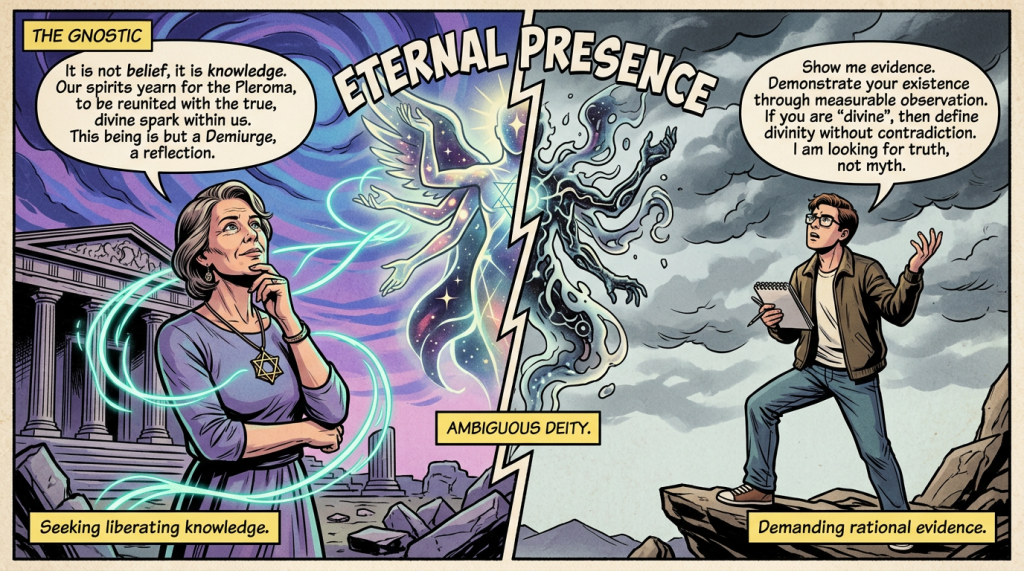
In an age that prides itself on moral clarity, few inversions are more revealing—or more dangerous—than the systematic reframing of divine justice as cruelty. The prophet Isaiah warned of precisely this: “Woe unto them that call evil good, and good evil; that put darkness for light, and light for darkness; that put bitter for sweet, and sweet for bitter!” (Isaiah 5:20, KJV).

That ancient indictment finds modern embodiment in Gnostic reinterpretations of Scripture and in certain atheist critiques that echo them. Both traditions take the Bible’s accounts of God’s mercy and judgment—particularly the Flood, the destruction of Sodom and Gomorrah, and the confounding at Babel—and invert them. What Scripture presents as righteous response to human wickedness becomes, in these readings, the malevolent act of a jealous or incompetent demiurge, or simply evidence that the biblical God is a moral monster.This is not a minor exegetical disagreement.
It is a comprehensive moral and theological reversal. Gnosticism, drawing from texts recovered at Nag Hammadi and related traditions, consistently portrays the Creator of the Old Testament as an inferior, ignorant, or tyrannical being—the Demiurge—who traps divine sparks in a flawed material world. Salvation comes through secret knowledge (gnosis) that liberates the spirit from this prison. In this framework, the God who judges sin is the villain; the pursuit of forbidden knowledge or resistance to His commands becomes heroic.
Certain atheist polemics, while rejecting the supernatural dualism, arrive at a parallel conclusion: the God of Genesis is a tribal, genocidal figure whose acts of judgment reveal Him as unworthy of worship. Both approaches call the biblical good evil and the biblical evil good.
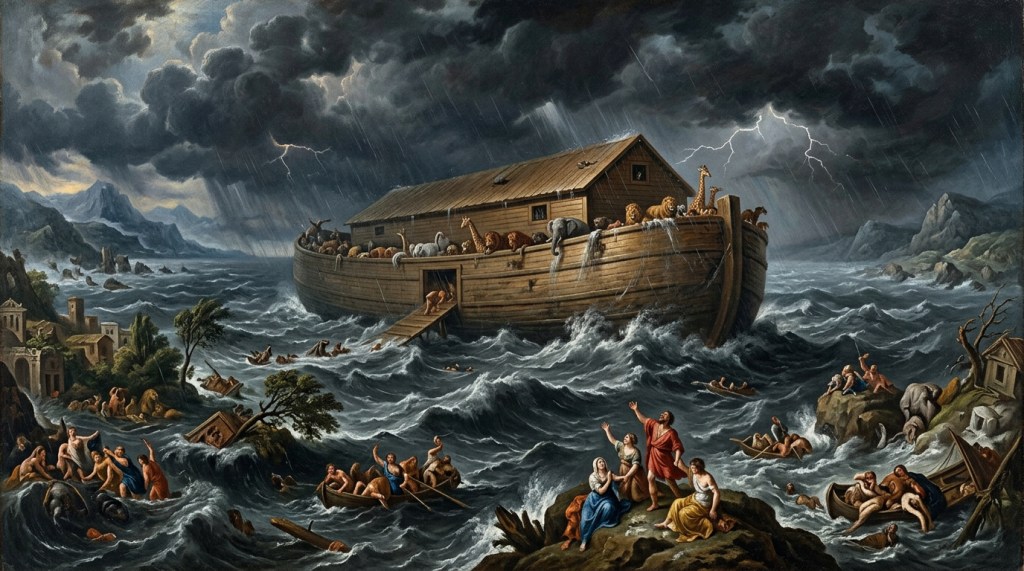
Consider first the Flood. Genesis 6 records that “GOD saw that the wickedness of man was great in the earth, and that every imagination of the thoughts of his heart was only evil continually.” The earth was “corrupt” and “filled with violence.” God, grieved at the heart, determined to destroy man and beast, yet Noah “found grace in the eyes of the LORD.” The same sovereign God who judges also preserves a remnant through the ark. This is mercy within judgment: restraint of escalating evil, protection of the righteous, and a new beginning sealed by covenant.
Gnostic accounts invert this narrative at its root. In texts such as the Hypostasis of the Archons and the Apocalypse of Adam, humanity is portrayed as multiplying and “improving”—gaining wisdom or spiritual insight. The rulers or the Demiurge, motivated by envy rather than justice, decide to obliterate all flesh. A higher or intermediate figure may warn Noah. The Flood becomes an act of cosmic jealousy aimed at suppressing emerging gnosis rather than a response to pervasive violence and corruption. What the Bible calls wickedness is recast as progress; what the Bible calls righteous judgment is recast as tyranny. Atheist critiques often parallel this by treating the Flood as indiscriminate slaughter of the innocent, ignoring the text’s insistence on universal moral collapse and the explicit offer of grace to Noah. Both readings refuse the biblical categories of sin and holiness, substituting instead a preference for human autonomy over divine assessment.
The same pattern appears in the destruction of Sodom and Gomorrah. Genesis 18–19 depicts cities whose “sin is very grievous.” The men of Sodom surround Lot’s house and demand that his angelic visitors be brought out “that we may know them.” The narrative is one of violent inhospitality escalating into attempted sexual assault, set against a broader backdrop of pride, excess, and neglect of the needy (Ezekiel 16:49-50) and “going after strange flesh” (Jude 1:7). Abraham intercedes; God investigates; only Lot and part of his household are delivered. Fire and brimstone fall as judgment. Again, mercy operates within justice: the righteous are distinguished and saved.

Gnostic tradition, notably in the Paraphrase of Shem and related interpretations, transforms Sodom into a place of enlightenment or spiritual purity—the home of those receiving higher knowledge. The destruction becomes an unjust assault by the Demiurge or base nature against the enlightened. The biblical cry of grievous sin is ignored or inverted; the cities become victims of divine envy rather than perpetrators of abomination. Atheist readings frequently reduce the episode to divine overreaction against sexuality or hospitality failures, stripping away the cumulative moral indictment and the careful distinction between judgment and deliverance. In both cases, the moral polarity is flipped: the Judge is the problem; the judged are the aggrieved.
The Tower of Babel completes the triad. Genesis 11 describes a unified humanity that settles in Shinar, builds a city and a tower “whose top may reach unto heaven,” and seeks to “make us a name, lest we be scattered.” This is explicit defiance of the post-Flood command to fill the earth. The LORD comes down, confounds their language, and scatters them. The act restrains a prideful project that would leave “nothing… restrained from them, which they have imagined to do.” It is both judgment and mercy: prevention of greater concentrated rebellion, and the providential origin of diverse nations.
Gnostic material, again drawing on the Paraphrase of Shem, associates the tower with demonic or lower powers seeking to protect a particle of light or achieve coherence against chaos. The confounding is reframed as suppression of spiritual aspiration or higher knowledge. Popular esoteric readings cast Babel as an enlightened attempt at unity or ascent, halted by a jealous deity. Atheist critiques often treat the story as primitive etiology or divine insecurity at human achievement.
Once more, human ambition is valorized; divine intervention is pathologized. The biblical diagnosis of pride and disobedience is replaced by a narrative of thwarted progress.

These inversions are not isolated. They flow from a shared refusal to accept the Bible’s fundamental claims: that the Creator is good, that creation was originally good, that human beings are accountable moral agents, and that sin incurs real consequences. Gnosticism dualizes reality so thoroughly that the material order and its Creator become the problem to be escaped. Atheism, in its more polemical forms, simply discards the premise of a just God and treats the judgments as evidence against theism itself. Both end up calling the biblical account of mercy-within-judgment “evil,” while treating rebellion, autonomy, or secret knowledge as “good.”
The consequences are not merely academic. When judgment is redefined as tyranny, the very possibility of moral accountability evaporates. If the Flood is envy rather than response to violence, then violence itself loses its moral weight. If Sodom is enlightenment rather than corruption, then the categories of sexual ethics and justice are inverted. If Babel is noble aspiration rather than pride, then human self-exaltation becomes the highest good. Isaiah’s warning is not abstract; it describes a society that can no longer distinguish light from darkness because it has systematically rewritten the moral map.
Scripture offers a different vision. The same God who judges is the God who preserves Noah, who delivers Lot, who scatters in order to restrain greater evil, and who ultimately enters history in the person of Christ to bear judgment Himself. Mercy and judgment are not opposites; they are coordinated expressions of holiness and love. To call one evil and the other good is to stand under the very woe Isaiah pronounced.

Gnosticism and certain atheist critiques do not merely misread these stories. They embody a deeper inversion that treats the biblical God as the problem and human (or demiurgic) resistance as the solution. That inversion remains attractive precisely because it flatters autonomy and relocates the source of evil outside the human heart. Yet the texts themselves refuse the flattery. They insist that the imaginations of the heart can be “only evil continually,” that cities can become grievously sinful, and that unified pride can threaten the moral order of the world. Against those realities, God’s acts of judgment are not the interruption of mercy but its necessary form.
Those who persist in calling these acts evil while celebrating the conditions that provoked them are not advancing enlightenment. They are fulfilling an ancient prophecy of moral confusion. The remedy is not further inversion but recovery of the categories Scripture itself provides: a good Creator, accountable creatures, real sin, and a justice that never ceases to make room for grace.
Don’t forget to Subscribe for Updates. Also, Follow Us at Society-Reviews, YouTube, Instagram, Twitter, Odysee, Rumble, and Twitch




Leave a Reply