

The United States occupies a unique and contested place in spiritual history. The nation’s historical role as a global exporter of the Christian gospel, a defender of biblical orthodoxy, and a steadfast ally of modern Israel has made it a primary object of opposition from the figure Scripture describes as the adversary.
While America does not appear by name in the Bible, patterns of deception, false teaching, and hostility toward God’s purposes outlined in the New Testament can be observed in the nation’s contemporary challenges. Three primary reasons for the spiritual hostility towards America by Satan, each tied to specific passages and modern developments.
A Missionary Superpower

The United States has sent more Protestant missionaries, funded more Bible translations, and sustained more international evangelistic efforts than any other country in modern history. The Great Commission in Matthew 28:19-20 and Mark 16:15, which command the gospel to be taken to “all nations” and “every creature.” The gospel itself is described as “the power of God unto salvation” (Romans 1:16).
In this framework, any force that systematically blinds minds to that message or hinders its spread (2 Corinthians 4:4; 1 Thessalonians 2:18) would regard a nation performing that work at scale as an obstacle. Analysts who hold this view see the rise of global movements that explicitly deny the crucifixion and resurrection of Jesus—central claims of the New Testament—as evidence of coordinated resistance. They frequently cite Islamic teaching that Jesus was neither crucified nor the divine Son of God, reading those denials through the tests of 1 John 2:22 and 4:3, which identify the “spirit of antichrist” with the rejection of Jesus as the Christ come in the flesh.
A Hub of Doctrinal Contention

America has long functioned as a center for the preservation and dissemination of what they regard as biblical orthodoxy. Seminaries, publishing houses, conferences, and media outlets based in the United States have spent decades contending against teachings they classify as “another gospel” (Galatians 1:8-9). Particular attention is given to 19th- and 20th-century American-origin movements. Mormonism, with its additional scripture and progressive view of deity, is measured against warnings not to add to the biblical text (Revelation 22:18-19; Proverbs 30:5-6) and against the claim that humans may become gods—an echo, these critics say, of the serpent’s words in Genesis 3:5.
The Five Percent Nation, which emerged from Harlem in the 1960s out of Nation of Islam circles, is similarly faulted for teaching that Black men are divine, for racial mythology that divides humanity, and for rejecting the cross in favor of esoteric knowledge. Both are presented as domestic counterfeits designed to divert people from the gospel of grace through faith alone (Ephesians 2:8-9).
An Ally of Israel
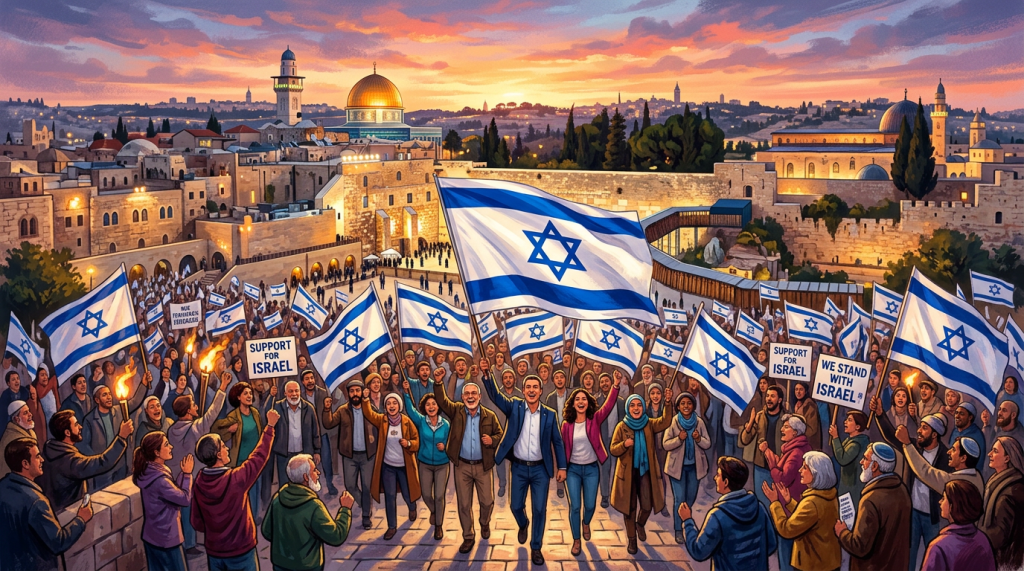
Third, the United States has been the principal military, diplomatic, and economic supporter of the modern State of Israel since 1948. Dispensational interpreters read Romans 9–11 as affirming an enduring, irrevocable calling for ethnic Israel. Key texts include Paul’s insistence that God has not cast away his people (Romans 11:1), the warning against Gentile arrogance toward the “natural branches” (Romans 11:18), the declaration that the gifts and calling of God are without repentance (Romans 11:29), and the prediction that “all Israel shall be saved” after a temporary hardening (Romans 11:25-26).
Support for Israel is therefore framed not merely as geopolitics but as alignment with divine faithfulness. Opposition to that support—whether through replacement theology that spiritualizes Israel’s promises into the church alone, or through rising antisemitic rhetoric that questions the legitimacy of Jewish self-determination—is interpreted as an attack on that alignment.
The Pattern of Counterattacks

From these premises, three corresponding strategies of opposition. The Islamic world, they argue, has long framed the United States as “the Great Satan,” a rhetorical posture that casts the nation’s missionary and strategic roles as existential threats. Domestic religious movements such as Mormonism and the Five Percent Nation are said to muddy doctrinal waters inside America, offering alternative paths to exaltation or racial enlightenment that compete with the message of the cross. Finally, theological and cultural currents that diminish Israel’s distinct future role or stoke hostility toward Jews are viewed as efforts to fracture the U.S.-Israel relationship that has underwritten the Jewish state’s security.
A nation that has projected the gospel of grace globally, guarded certain boundaries of orthodoxy, and stood with the people to whom Paul assigned an enduring calling would, in their view, inevitably draw the enmity of the figure the New Testament calls “the adversary” and “the god of this world.” The argument does not claim prophetic prediction of America by name. It claims pattern recognition: where the gospel advances, where false teaching is challenged, and where God’s stated purposes for Israel are supported, opposition follows.
Don’t forget to Subscribe for Updates. Also, Follow Us at Society-Reviews, YouTube, Instagram, Twitter, Odysee, Rumble, and Twitch



Leave a Reply