
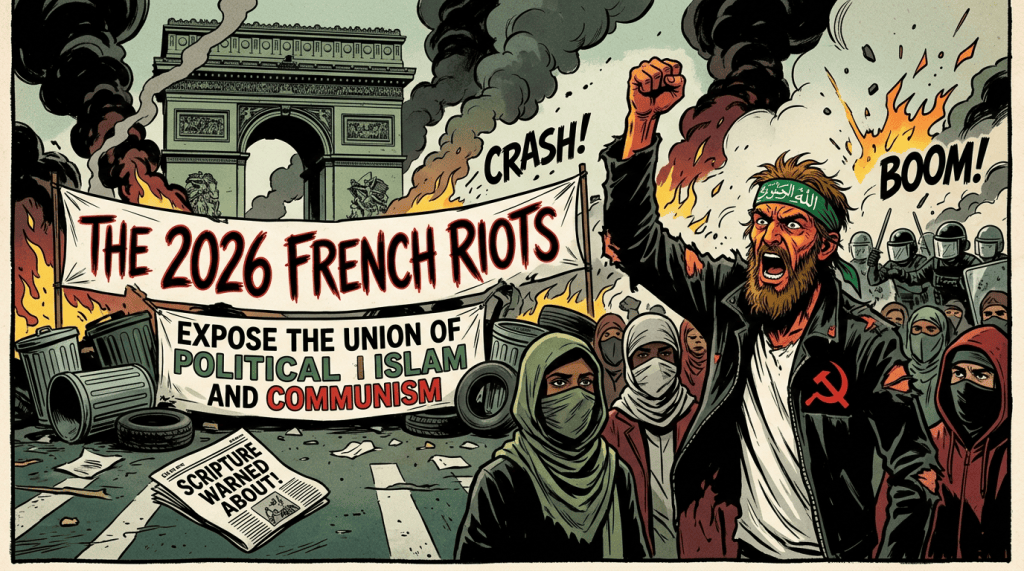
The images coming out of France this week do not look like a labor dispute.
They look like a declaration.
In Limoges, the Hôtel de Ville—a building that survived the German occupation—is now a blackened shell, its tower collapsed into flame. In Paris streets and squares, Palestinian and Algerian flags dominate crowds that officials describe as students angry about school funding and the cost of living. On monuments once reserved for the Republic, the same flags wave while men in dark clothing and yellow vests occupy the stonework.
A MEMRI-translated video circulating alongside the footage records a speaker addressing President Macron directly: “with jihad, we will destroy your honor… tomorrow, we will conquer Paris.” The banner behind him references the caliphate and the liberation of Al-Aqsa.
These are not the visual signatures of a tax protest. They are the signatures of a political movement that has fused territorial grievance, religious supremacism, and revolutionary street tactics. To insist, against the evidence of the flags, the chants, the selective destruction of civic symbols, and the explicit conquest rhetoric, that the unrest is primarily about “students and taxes” is not analysis. It is narrative management.
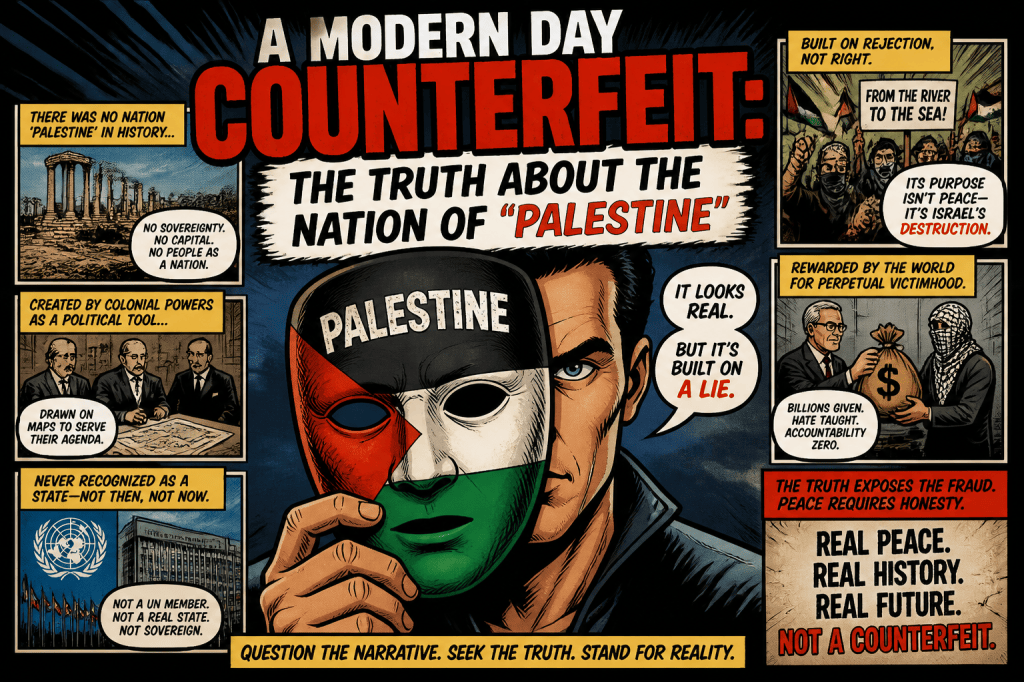
The pattern is familiar to anyone who has watched the last three years. After October 7, 2023, the Palestinian cause became the preferred vehicle for a broader coalition: Islamist networks, far-left parties and student groups, and segments of Western progressive media and academia. In France the alliance is especially visible because the country has already conducted large-scale demographic experiments and because its political class has repeatedly chosen recognition and accommodation over enforcement of its own borders and laws.
France was among the earlier Western states to recognize a Palestinian entity. The current street scenes—Palestinian flags on the Republic’s monuments, the absence of French flags in certain “student” gatherings, the burning of a historic city hall—are being read by many French observers as the reciprocal recognition.
What makes the hybrid potent is its complementarity. Political Islam supplies a durable religious identity, a doctrine of territorial expansion, and a willingness to treat certain lands and peoples as permanently contested. The far left supplies the language of anti-colonialism, the organizational infrastructure of universities and NGOs, the moral inversion that treats disorder as justice, and the institutional reluctance to name patterns that contradict the preferred story. Together they generate a force that is neither purely economic nor purely confessional. It is composite. It can march under the banner of better schools while the footage shows the flags of a cause whose dominant political expression rejects the legitimacy of a Jewish state and, in its more explicit forms, the legitimacy of Western public order itself.
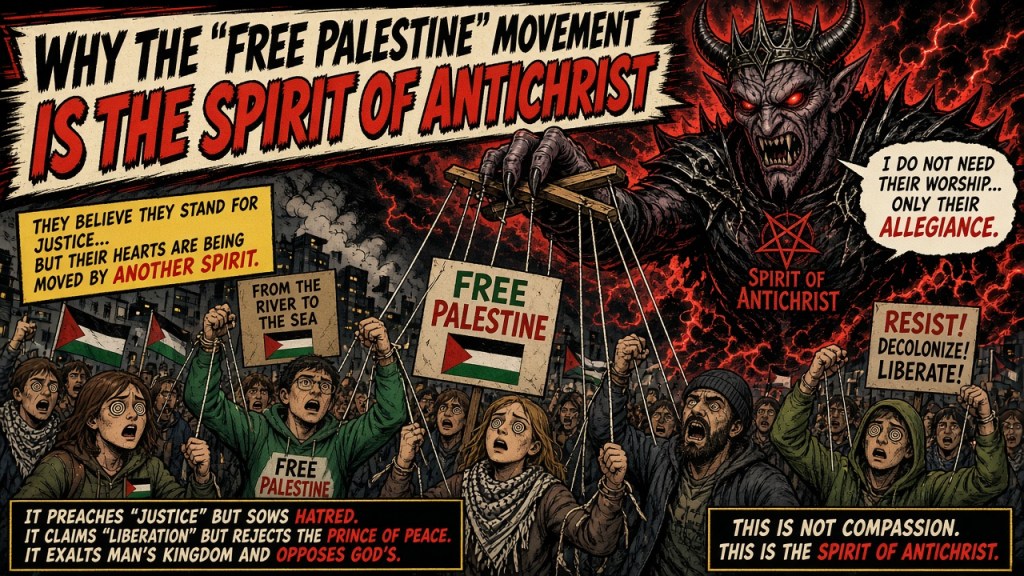
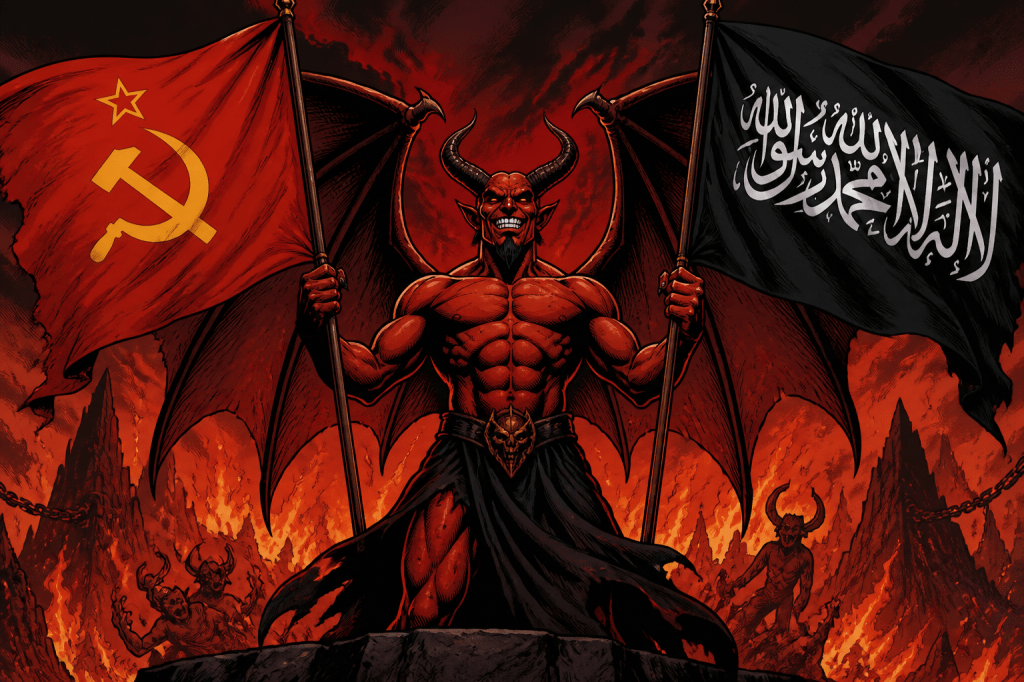
This is the configuration that several recent analyses have argued matches the structural features of the “beast” system described in Daniel 7 and Revelation 13. Those texts do not name twenty-first-century parties or religions. They describe a power that rises from the sea of nations, is diverse in its parts, speaks blasphemy against God, makes war on the saints, and exercises coercive authority over buying, selling, and public loyalty.
The religious component denies the Son’s unique relation to the Father and the finished work of the cross (1 John 2:22; 4:3). The political-economic component supplies the apparatus of control and the revolutionary energy that can be mobilized against existing order. The French scenes do not fulfill those prophecies. They illustrate why the hybrid is attractive to people who have already discarded the older restraints: it offers both transcendent certainty and earthly power, both a sacred geography and a street-level praxis.
The official minimization is therefore not a minor factual disagreement. When governments and major outlets describe crowds waving Palestinian flags and occupying monuments as primarily concerned with education budgets, they are asking the public to ignore the most salient symbols in the footage. That is a choice. It is the same choice that, for years, treated large-scale migration from societies with high levels of Islamist political organization as an unalloyed economic and moral good, and that treated any empirical discussion of differential outcomes or parallel societies as illegitimate.
Romans 1 describes a process in which societies that will not retain God in their knowledge are given over to a reprobate mind and to the social consequences of that choice. The French unrest is one visible consequence. The buildings that burned were not random; the flags that flew were not random; the rhetoric of conquest that accompanied them was not random.
None of this requires the claim that every protester is a jihadist or that every economic grievance is fabricated. Large numbers of French citizens have legitimate complaints about purchasing power and public services. The point is that those complaints have been captured, in significant measure, by a coalition whose symbols, alliances, and stated aims point elsewhere. The useful-idiot function of the far left is not a new observation; it is simply being enacted again in real time, with better cameras. The result is a form of political Islam that no longer needs to conquer territory by classical armies alone. It can expand inside open societies by demographic weight, institutional capture, and the moral paralysis of elites who fear the charge of Islamophobia more than they fear the erosion of their own public order.
Western governments still retain the formal power to reverse course. They can enforce existing immigration law, insist that public demonstrations display the flags of the host nation rather than those of foreign political causes, and refuse to treat the denial of Jewish legitimacy or the open invocation of jihad as protected speech when it is paired with violence. Whether they will do so is another question. The alternative is continued accommodation of a hybrid that has already demonstrated, in France this week, that it can turn a cost-of-living protest into a display of dominance and that it can reduce a building that survived the Wehrmacht to rubble while the narrative class explains that the real issue is school funding.
The texts that describe the end-time power do not require us to identify any present coalition as its final form. They do require us to notice when the traits—blasphemy against the God of Israel, hostility to the covenant people, coercive pressure on public life, and a composite character drawn from many nations—begin to assemble in the open. The footage from Limoges and Paris is not ambiguous on that score. The attempt to make it ambiguous is.


Leave a Reply