
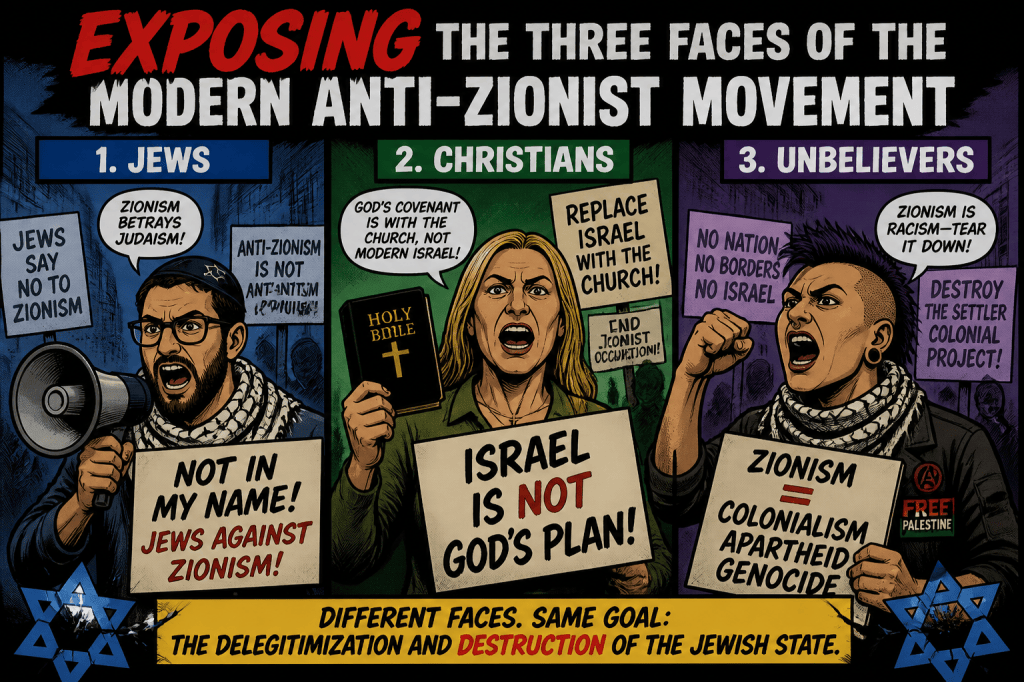
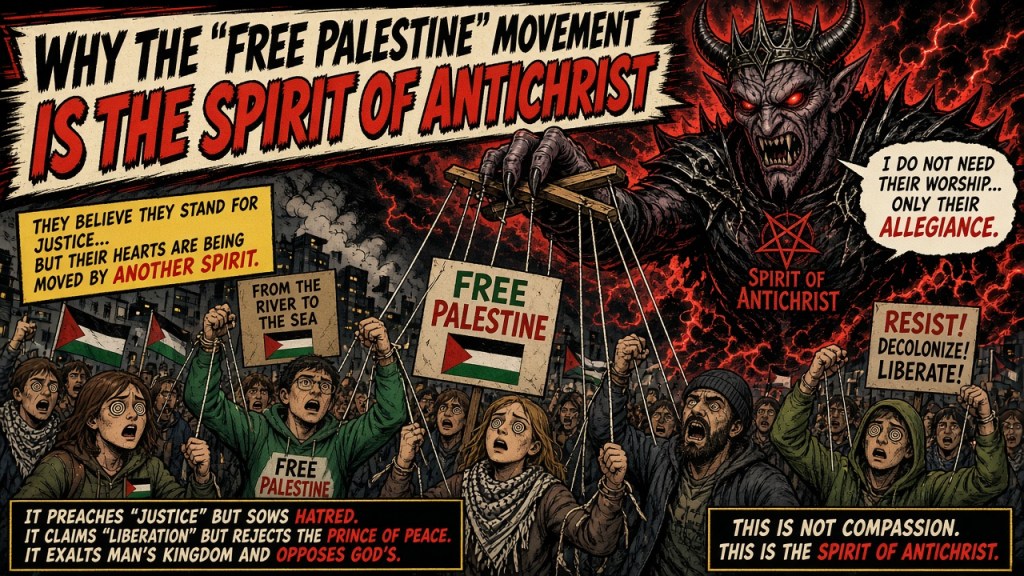
Anti-Zionism presents itself as a political position. However, the movement has rapidly turned itself into a litmus test that whoever supports the nation of Israel and it’s people is an enemy to society.
In practice it is a coalition of three distinct groups that have arrived at the same conclusion by different routes: the Jewish people have no enduring title to the land God promised Abraham, Isaac and Jacob, and the restored Jewish presence in Jerusalem is therefore illegitimate. A literal reading of the Bible does not support that conclusion. The modern movement that treats it as self-evident is not a new insight. It is an old error wearing new clothes.

The Unbelievers (Gentiles Who Reject Jesus Christ)
The first group requires no theology. It simply denies Jewish peoplehood or treats Jewish self-determination as uniquely suspect. Its language is secular: settler-colonialism, apartheid, genocide. Its methods are familiar—boycotts, campus encampments, diplomatic isolation, and the systematic inversion of the name “Palestine.”
That name is not an ancient Arab title. The Philistines of Scripture were Caphtorites, descendants of Mizraim, who displaced the Avim on a narrow coastal strip (Genesis 10:14; Deuteronomy 2:23; Amos 9:7). They were never the heirs of the Abrahamic grant. After they vanished as a people under Babylonian conquest, Rome revived their name in the second century A.D., renaming Judaea “Syria Palaestina” after the Bar-Kokhba revolt in order to sever the Jewish connection to the land. The modern claim that this Roman insult constitutes a deed is historical alchemy.
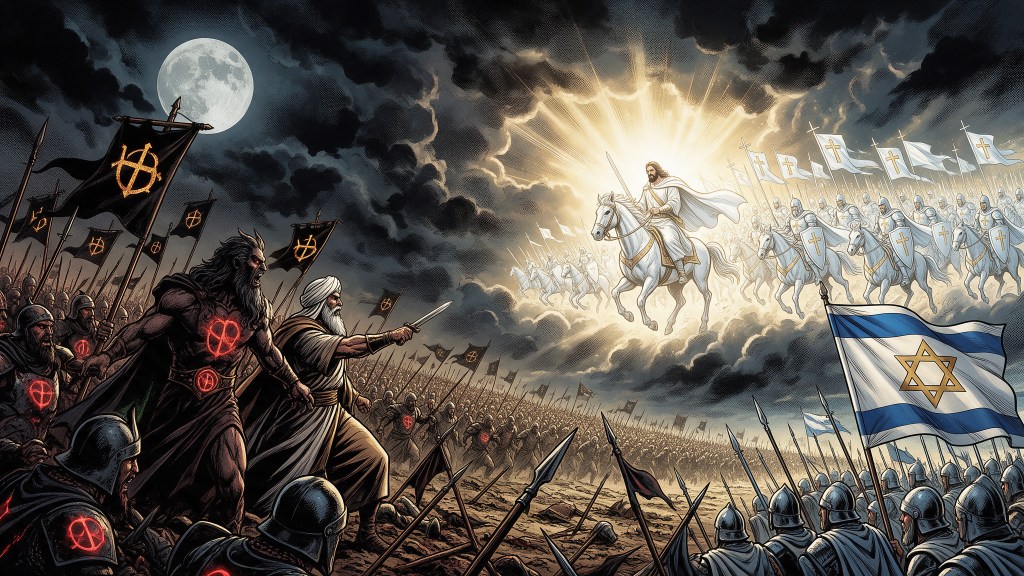
The same group now gathers “all the people of the earth” against Jerusalem in the manner Zechariah 12 describes. Nearly 49,000 demonstrations across 137 countries since October 2023, BDS activity in 130 countries, and a wave of recognitions of a Palestinian state by more than 150 United Nations members are the political expression of that gathering. In the entertainment industry the gathering has become fashionable. In September 2025 more than 4,000 film workers, including Mark Ruffalo, Emma Stone, Olivia Colman, Javier Bardem and Joaquin Phoenix, pledged to boycott Israeli festivals and production companies they deemed “implicated in genocide and apartheid.” Red-carpet keffiyehs and awards-show slogans followed. A counter-letter signed by more than 1,200 industry figures called the pledge collective punishment; major studios rejected it as discriminatory. The cultural campaign continues anyway.
Zechariah 12:3 is not subtle: “all that burden themselves with it shall be cut in pieces, though all the people of the earth be gathered together against it.” The unbelievers have taken up the stone.

The “Church” (The Tares IN The Wheat)
The second group is more dangerous because it claims the Bible as warrant. It collapses three distinct covenants into one broken contract. The Abrahamic covenant is everlasting and unilateral: land as “an everlasting possession” to Abraham’s seed through Isaac, not Ishmael (Genesis 17:7-8, 19-21; 26:3-4; 35:12). The Mosaic covenant is conditional; national disobedience brought exile, exactly as Deuteronomy predicted. The Davidic covenant promises an enduring throne. Antisemites who wave Scripture typically ignore the first and third covenants, note Israel’s failure under the second, and declare the entire people cast off.
Paul, a Jew of Benjamin, asked whether God had cast away His people and answered no (Romans 11). The new covenant is announced with the house of Israel and the house of Judah. Replacement Theology and its anti-Zionist cousins treat the Church as having inherited the promises while the Jews inherited only the curses. Zechariah 12 addresses both the nations and the Church: cheering the siege of Jerusalem places believers on the wrong side of the God who said He would defend the city and destroy the nations that come against it. “Boast not against the branches,” Paul wrote. The warning still stands.
These believers supply moral cover. They baptize the gathering. They turn a political campaign into a sacred duty.
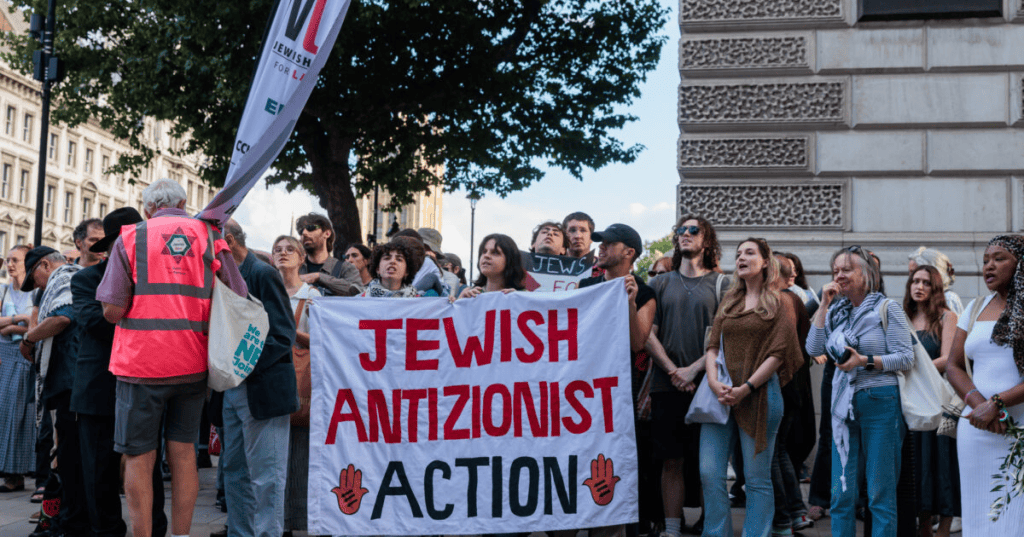
The Jews against Zion
The third group is the smallest and the most rhetorically useful to the first two. First-century Judaism already contained the temperaments that reappear today. The Essenes withdrew into purity and waited for divine, not human, redemption; their modern heirs include Neturei Karta and similar Haredi circles that declare the Jewish state a heretical rebellion because the Messiah has not yet come.
They refuse the “Zionist army” and sometimes embrace Israel’s enemies. The Sadducees were the accommodating elite who rejected resurrection and angels; their spirit lives among secular and Reform Jews who treat particular Jewish claims to peoplehood and land as an embarrassment to be subordinated to universal causes. Some of them sign the same Hollywood pledges, shout the same slogans, and frame the Jewish state itself as the obstacle to justice.
They remain minorities. Most Jews, and virtually all Israeli Jews, accept the legitimacy of Jewish sovereignty even when they criticize governments. Their existence does not cancel the covenant. It does illustrate Zechariah’s realism: the gathering against Jerusalem can recruit even from within Judah. The prophets never treated Mosaic failure as revocation of the Abrahamic grant. Neither should we.
The text does not negotiate
Legitimate criticism of Israeli policy is not the issue. Demanding that Jews alone among the nations justify their existence, or treating their return to the land promised as an everlasting possession as uniquely illegitimate, is the issue. The Philistines were not the heirs. Islam arrived more than two millennia after the covenant was spoken. The Roman name “Palestine” was a punishment, not a title. The Abrahamic promise was not transferred to Ishmael. Zechariah 12 does not describe a debate. It describes a siege, a stone that injures those who lift it, and a God who opens His eyes upon the house of Judah.
The modern anti-Zionist movement—unbelieving, believing, and intramural—has taken up that stone. The prophet already recorded what happens next.



Leave a Reply