
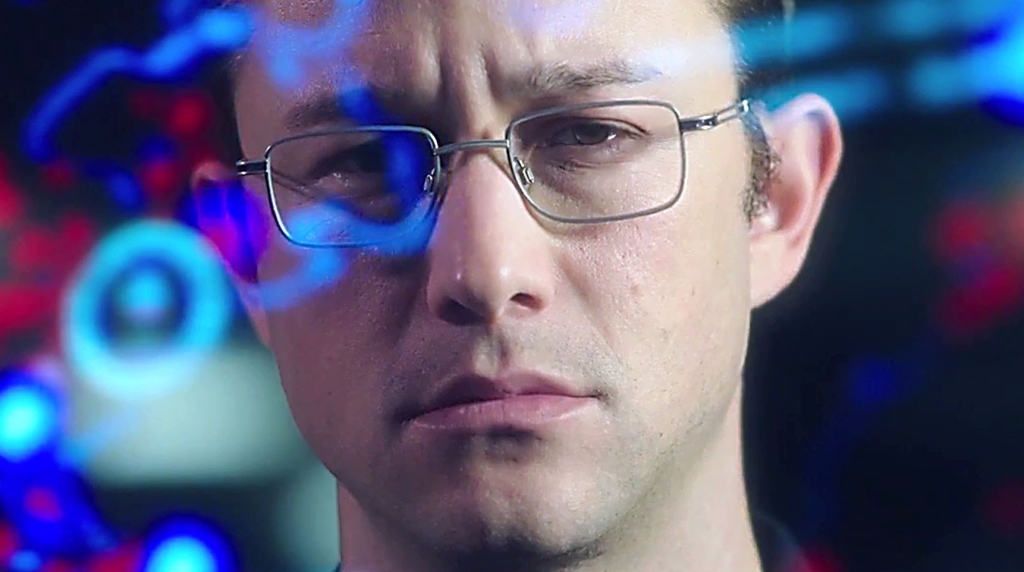
The curious case of Edward Snowden has become one of the most polarizing topics of the last decade. Depending on whom you ask, Snowden is either a patriot who risked everything to expose government overreach or a traitor who endangered national security. For those less familiar with the details, Edward Snowden is a former CIA employee and NSA contractor who, in 2013, leaked classified information revealing the scale of global surveillance programs conducted in the name of counter-terrorism. To this day he lives in exile, facing espionage charges in the United States. In 2013, director Oliver Stone began developing a biopic about these events. Given the secrecy surrounding both the real story and the production itself, the question is whether the finished film matches the drama of its subject.
Snowden opens in a Hong Kong hotel room where Snowden (Joseph Gordon-Levitt) is meeting with journalists, including representatives from The Guardian, to hand over the documents he has taken from the NSA. Most of the film unfolds through flashbacks that trace how he arrived at that moment. After an injury ends his attempt to enlist in the military, Snowden eventually joins the CIA’s cyber-focused programs. He impresses his superiors by completing a demanding five-hour test in just 38 minutes and is taken under the wing of a mentor figure, Corbin O’Brian (Rhys Ifans), who sees great potential in him. As Snowden moves deeper into intelligence work, however, he becomes increasingly disturbed by the ethical boundaries being crossed and by the sheer reach of the surveillance apparatus into ordinary people’s lives. One could reasonably respond, “Well, it’s the CIA—what did you expect?” The film’s stronger question is more personal: How far would you go, and what would you sacrifice, in the name of protecting your country?
Unlike many politically charged films, Snowden does not pin all the blame on a single presidential administration. Snowden is portrayed as initially more conservative-leaning. Over time he grows disillusioned with the expansion of surveillance under the Bush administration and places hope in the incoming Obama administration, only to watch the programs continue and, in some respects, grow. Shailene Woodley plays Lindsay Mills, Snowden’s liberal photographer girlfriend. She repeatedly senses his stress and distance but is kept in the dark for her own safety—an understandable choice that still creates real strain in their relationship.
The film assembles a strong roster of actors, yet many of them feel underused. Nicolas Cage and Timothy Olyphant, among others, appear only briefly and are given relatively little to do. A more significant issue is that the tension rarely rises to match the stakes. For a story about a man leaking highly classified material and then going on the run, the sense of immediate danger is surprisingly muted. Because most viewers already know the broad outcome of the real events, generating sustained suspense is inherently difficult. That said, Oliver Stone clearly went to considerable lengths to stay close to the known facts. He and Joseph Gordon-Levitt met with Snowden multiple times in Moscow. Portions of the production were moved outside the United States, in part out of concern about possible interference. Snowden himself appears in a brief cameo near the end, offering a direct statement about why he believed his actions were necessary.
There are, of course, elements of the larger story that the film does not explore in depth—among them allegations about how Snowden obtained asylum and what, if anything, was shared with other governments. Those omissions mean that any final judgment of Snowden as patriot or traitor remains largely in the viewer’s hands. As a piece of filmmaking, however, Snowden is a solid and thoughtful effort. Joseph Gordon-Levitt delivers a restrained, convincing performance, capturing both the technical confidence and the growing moral unease of the man at the center. Stone’s direction can feel heavy-handed in places, as is often the case with his more politically engaged work, yet the overall result is a serious biopic that refuses to reduce its subject to a simple hero or villain.
Snowden is not a pulse-pounding thriller, nor is it the definitive last word on its controversial subject. It is a well-crafted, deliberately paced examination of one man’s decision and the system that pushed him toward it. The film succeeds in raising questions about the balance between security and privacy, legality and morality, that remain relevant long after the credits roll. It may not convert skeptics on either side of the debate, but it gives both something substantial to argue about.
3/5





Leave a Reply