
Christmas movies built around predominantly Black casts have become a reliable yearly tradition in Hollywood. I hesitate to call them “Black Christmas movies” only because the phrase still triggers uncomfortable memories of a certain earlier film I walked out of roughly a decade ago. Historically the quality of these seasonal entries has been uneven. For every well-regarded title such as The Best Man Holiday or Soul Food, there are broader, less successful efforts like The Perfect Holiday or A Madea Christmas that most audiences would prefer to forget. In that mixed company, Almost Christmas arrives as a mid-tier offering that aims for warm family comedy while remaining firmly in the shadow of the bigger holiday releases.
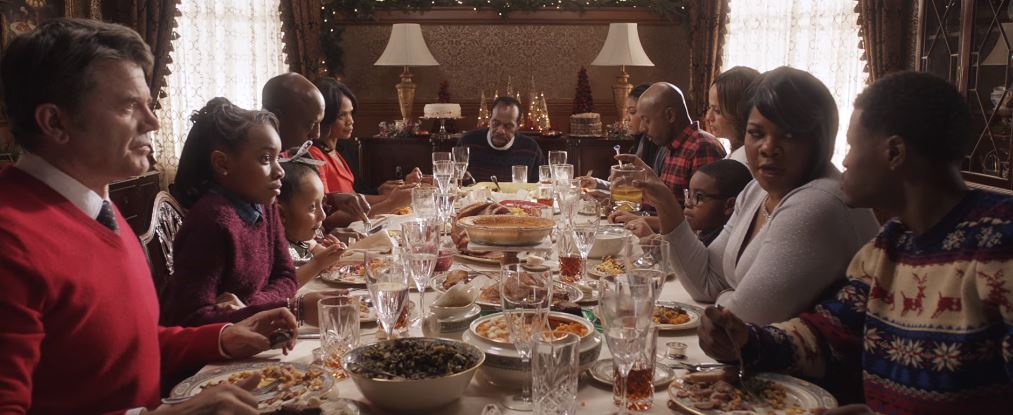
The film opens with a chronological montage that traces a couple’s relationship from the 1970s through the present day. Danny Glover plays Walter, a retired man facing his first Christmas without his longtime wife, who passed away the previous year. He invites his adult children and extended family for a multi-day reunion under one roof. The group includes a son running for Congress, a former professional basketball player, a standout college football prospect, two strong-willed and frequently clashing sisters, and a free-spirited aunt whose comic energy threatens to dominate every scene she enters. The plan is five days of togetherness, shared meals, and holiday tradition. Predictably, old grievances, new romantic complications, professional pressures, and assorted hijinks quickly threaten to turn the gathering into a full-blown holiday disaster.
What often frustrates me about this particular style of ensemble holiday film is the heavy reliance on soap-opera mechanics. Conflicts tend to feel manufactured for maximum dramatic effect, and many of the emotional beats land with the broadness of daytime television. Beyond the central and genuinely affecting premise of a family navigating grief during the holidays, much of the plotting leans on familiar tropes: the ambitious sibling who prioritizes career over family, the underachiever still finding his footing, the sisters who cannot stop arguing, and the relative whose personal life is a walking punch line. Character development outside the core father-and-children dynamic remains limited. When the story itself is this thin, the cast has to work overtime to keep the audience engaged.
Fortunately, several performers rise to the occasion. J.B. Smoove and Mo’Nique seize every scene they appear in, delivering the sharpest and most consistent comic energy in the film. Their timing and willingness to go big prevent long stretches from sagging. Danny Glover brings steady charm and quiet dignity; he carries the emotional weight of the story without overplaying the sentimentality. Jessie T. Usher displays an easy, natural charisma that makes one wonder why that same spark felt missing from some of his earlier high-profile roles. The rest of the ensemble is serviceable, even if a few characters feel more like plot functions than fully realized people.
The writing has clear limitations. Not every family member receives equal attention or a satisfying arc, and some subplots resolve with convenient neatness. Yet the movie remains an easy, good-natured watch. It captures the recognizable chaos of a large family forced into close quarters for an extended period, and it does so without becoming mean-spirited or cynical. Multiple generations are represented on screen, which helps the film feel accessible whether the viewer is a teenager or a grandparent. It never reaches the heights of the stronger entries in the holiday-ensemble category, but it also avoids the outright failures that make certain seasonal releases painful to sit through.
Almost Christmas is the cinematic equivalent of a serviceable holiday sweater: not the most stylish or memorable item in the closet, yet comfortable enough to wear for the occasion. The laughs arrive with reasonable frequency, the emotional core is sincere even when familiar, and the stronger members of the cast keep the energy from flagging. It is not a classic, nor is it destined for annual must-watch status. It is, however, a pleasant enough way to spend a couple of hours when the alternative is another generic seasonal offering. For audiences simply looking for light family comedy set against a recognizable holiday backdrop, the film hits enough of the right notes to earn a mild recommendation.
In the end, Almost Christmas
2.5/5








Leave a Reply