
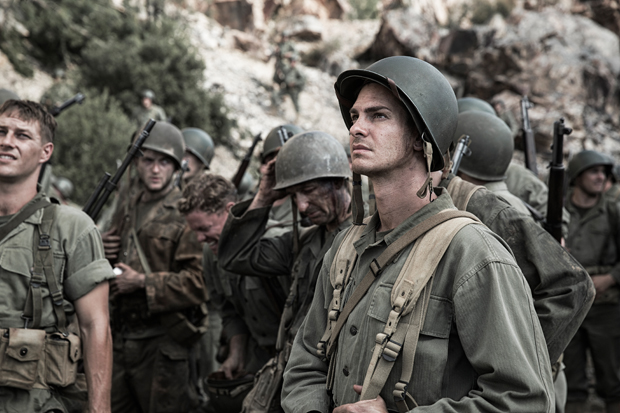
I have reached the point where the announcement of a new World War II movie often draws an audible groan. Hollywood seems determined to remind audiences, repeatedly, that the Nazis were the villains of the 1940s—as if anyone were in danger of forgetting. The same broad narrative beats return so regularly that it is fair to ask whether the genre has grown creatively exhausted. Who better, then, to shake up expectations than Mel Gibson? Hacksaw Ridge is the biographical account of U.S. Army medic Desmond T. Doss, who received the Medal of Honor for saving the lives of 75 men during the Battle of Okinawa—without ever carrying a weapon. The project spent years in development before Gibson and Andrew Garfield finally brought it to the screen. Whatever one’s personal feelings about the director, the film itself centers on one of the most remarkable acts of bravery in American military history.
The story begins with Doss’s early life in a small Virginia town. Raised alongside his brother by parents whose marriage is strained by the father’s alcoholism and lingering trauma from the First World War (Hugo Weaving), Doss grows up with a deep religious conviction as a Seventh-day Adventist. After the attack on Pearl Harbor, enlistment surges across the country. Doss wants to serve, but he is determined to do so as a medic who will not take human life. That stance creates immediate and intense conflict with the Army. He is labeled a coward, subjected to harassment, and pressured to quit. Yet the Constitution protects his right to serve according to his beliefs, and he eventually reaches the brutal battlefield of Okinawa.
Many involved with the film have described it as occupying a space between faith-based drama and anti-war statement. The first half focuses on Doss’s struggle to remain true to his principles in an institution built around the use of force. Vince Vaughn and Sam Worthington, as his sergeant and captain, put him through relentless trials in the hope that he will break. He does not. His quiet persistence gradually earns a measure of respect from the men around him and sets the stage for what follows.
It would be irresponsible not to note that this is a Mel Gibson film. Anyone familiar with The Passion of the Christ or Apocalypto knows the director does not shy away from graphic violence. The combat sequences on Hacksaw Ridge are among the most intense and unflinching depictions of warfare in modern cinema. The American forces attempt to take a heavily defended escarpment against ferocious Japanese resistance; the resulting carnage is presented in raw, overwhelming detail. For a movie that begins with the rhythms of a small-town character study, the second half is startlingly brutal. That brutality serves a purpose: it makes the stakes of Doss’s actions unmistakable. While chaos and slaughter unfold around him, he repeatedly returns to the ridge, lowering wounded men to safety one by one, driven by the simple prayer to save just one more.
Desmond Doss was the embodiment of a particular kind of American heroism—courage expressed through mercy rather than aggression. The film closes with footage of the real Doss reflecting on his experiences shortly before his death in 2006. Hearing his own words deepens the impact of everything that has come before. While the violence will be too much for some viewers, Gibson strikes a remarkable balance between the horror of war and the steadfast peacefulness of his central character. Questions about the director as a person are ultimately separate from the quality of the work on screen. The ensemble is strong across the board, with standout support from Hugo Weaving and Teresa Palmer, but it is Andrew Garfield’s performance that anchors the film. He conveys Doss’s conviction and quiet strength with such sincerity that the emotional force of the story is impossible to shake.
Hacksaw Ridge is one of the most powerful films of its year and, for my money, one of the best of 2016. It honors a extraordinary true story without sentimentality, delivers craftsmanship of a high order, and leaves a lasting impression. It deserves to be seen and remembered.
5/5




Leave a Reply