
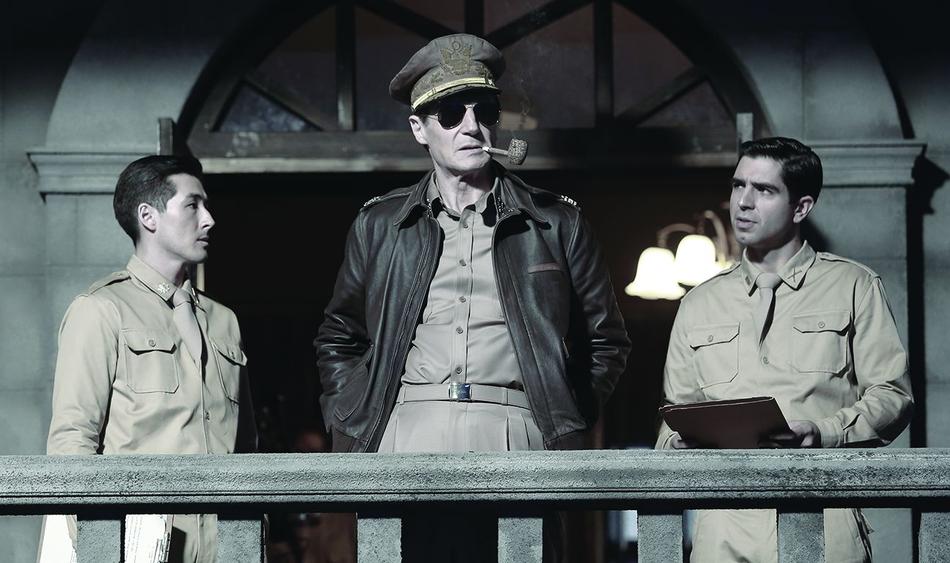
Operation Chromite is based on the real-life events leading up to the 1950 Battle of Inchon during the Korean War. The operation’s code name refers to the daring mission to recapture the port city of Incheon (and ultimately Seoul) from North Korean forces. The architect of the plan was General Douglas MacArthur of the U.S. Army, played here by Liam Neeson. Many military historians still regard the Inchon landing as one of the most successful and audacious operations in modern warfare—odds that were estimated at roughly 5,000 to 1 against success. An incredible true story like this should translate into a great film, right?
The movie begins with a team of eight South Korean spies working in coordination with United Nations forces. Their mission is to infiltrate North Korean-held territory under the regime of Kim Il-sung and his hardline defense commander, Lim Gye-jin (Lee Beom-soo). Led by Navy Lieutenant Jang Hak-soo (Lee Jung-jae), the spies must map the extensive minefields protecting the approaches to Incheon so that MacArthur’s invasion force can safely land. The film intercuts their dangerous undercover work with MacArthur’s efforts in Tokyo to convince skeptical superiors that the high-risk amphibious assault is worth attempting.
Liam Neeson is the biggest international name attached to the project, but his role is relatively limited. Most of his scenes take place in war rooms and briefing areas, where he wears dark glasses and delivers decisive, gravelly-voiced commands from a distance. While MacArthur is clearly the driving force behind the Inchon plan, the film mostly shows him in the role of a determined bureaucrat fighting political and military resistance to his controversial strategy. Neeson still manages to deliver some of the movie’s strongest and most memorable lines, even with the restricted screen time.One of the film’s notable weaknesses is its structure. The script often feels like three different movies stitched together: a spy thriller, a character-driven war drama, and a large-scale battle picture. The first half leans heavily on the espionage plot, which results in a deliberately slow pace as the undercover team gathers intelligence and tries to maintain their cover. Once the action accelerates, the violence is appropriately brutal for a war film. However, the CGI during the climactic battle sequences looks rough and under-rendered. Whatever the budget constraints were, the digital effects never fully convince.
Lee Beom-soo’s performance as the North Korean commander borders on classic villainy—cold, ruthless, and perpetually menacing. Every time he appears on screen, the tension rises. The cat-and-mouse game between Jang Hak-soo and Lim Gye-jin is one of the film’s highlights, playing out like a high-stakes match of human chess as both men demonstrate sharp military instincts and strategic thinking. The movie also does solid work establishing the personal stakes for the South Korean spies. Their connections to family and their desire to protect the next generation give real emotional weight to the sacrifices they are willing to make against the communist regime.
The conclusion delivers a large-scale battle as UN forces clash with North Korean troops for control of the port of Incheon and, by extension, the future of South Korea. The sequence is chaotic and intense, even if the visual effects occasionally undercut the impact.Operation Chromite has clear pacing and script problems, yet it still offers a worthwhile perspective on a critical and often overlooked chapter of the Korean War. The action, when it arrives, is tense and unpredictable—you genuinely don’t know who will survive until the final moments. While Liam Neeson’s role is smaller than the marketing might suggest, he remains effective. If the screenplay had been more tightly focused and the visual effects sharpened, this could have ranked among the stronger war films of the year.
As it stands, Operation Chromite is a solid recommendation for fans of Asian cinema and for history buffs interested in the stories of the unsung heroes who risked everything in what is sometimes called “the Forgotten War.”
3/5




Leave a Reply