In the vast marketplace of modern Bible translations, the New International Version (NIV) and New Living Translation (NLT) reign supreme among American readers.

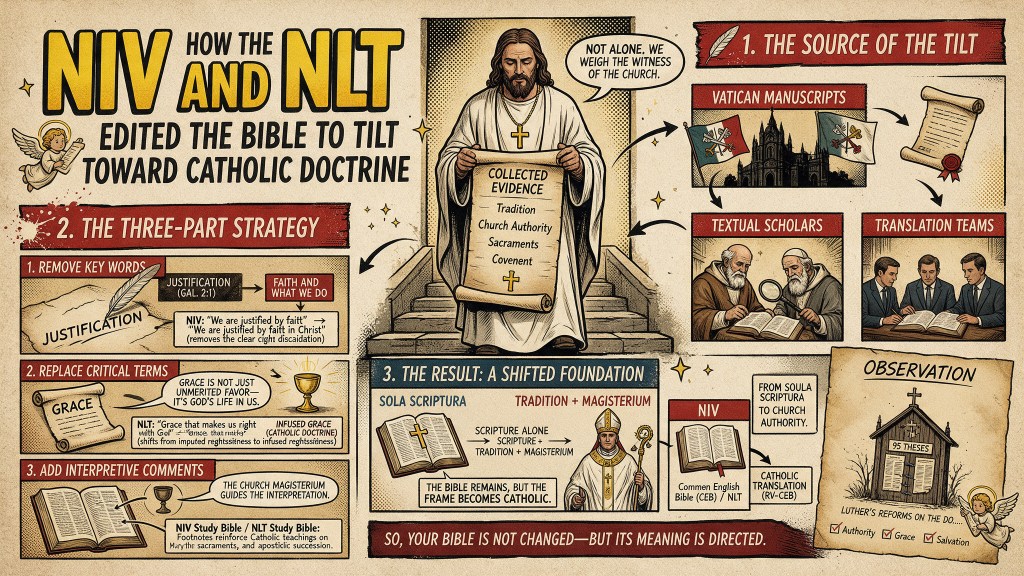
The NIV, first published in 1978 and updated in 2011, claims over 500 million copies in print. The NLT, launched in 1996 by Tyndale House, markets itself as “clear, accurate, and easy to read.” Yet a close examination of their textual choices — measured against the King James Bible (KJB) as the historical Protestant standard — reveals a pattern of omissions and alterations that systematically align with Roman Catholic Church (RCC) teachings while eroding doctrines central to Reformation theology.
This is not mere scholarly debate; it is a question of whether two of the nation’s most trusted Bibles have, in effect, become Catholic-friendly texts.
The Textual Foundation: A Shared Critical Text
Both the NIV and NLT rely on the Critical Text (CT), specifically the Nestle-Aland/United Bible Societies Greek New Testament, which draws heavily from two fourth-century manuscripts: Codex Vaticanus (housed in the Vatican Library) and Codex Sinaiticus. These manuscripts, favored by Catholic scholars since the 19th century, differ significantly from the Textus Receptus (TR), the Greek text underlying the KJB and used by the Protestant Reformers.

The CT omits or brackets approximately 17 full verses present in the TR and alters thousands of words. While the NIV and NLT present these changes as scholarly refinements, the pattern of what is removed — and what remains — consistently favors RCC doctrine over the KJB’s clarity.

Verse by Verse: Omissions That Favor Catholic Teaching
- Acts 8:37
- KJB: “And Philip said, If thou believest with all thine heart, thou mayest. And he answered and said, I believe that Jesus Christ is the Son of God.”
- NIV/NLT: Entire verse omitted (footnote: “Some manuscripts include…”)
- Impact: This verse requires a personal confession of faith before baptism. Its removal supports the Catholic practice of infant baptism without belief (Catechism of the Catholic Church, CCC 1257), which imparts grace ex opere operato — by the act itself.
- 1 Timothy 3:16
- KJB: “God was manifest in the flesh…”
- NIV: “He appeared in the flesh…”
- NLT: “He appeared in a human body…”
- Impact: The change from “God” (Theos) to “He” (hos) weakens the explicit declaration of Christ’s deity. While Catholics affirm the Incarnation, the softening aligns with their emphasis on Mary as “Mother of God” (CCC 971) rather than Christ’s standalone divine identity.
- Colossians 1:14
- KJB: “In whom we have redemption through his blood…”
- NIV: “…redemption, the forgiveness of sins.” (“through his blood” omitted)
- NLT (2015): Retains “by his blood,” but earlier editions omitted.
- Impact: The NIV’s omission downplays the blood atonement, central to Protestant theology (Hebrews 9:22). This aligns with the Catholic Mass as an “unbloody sacrifice” (CCC 1367), where Christ is re-presented without literal blood.
- Matthew 6:13 (Lord’s Prayer Doxology)
- KJB: “For thine is the kingdom, and the power, and the glory, for ever. Amen.”
- NIV/NLT: Omitted entirely
- Impact: The Catholic liturgy ends the Lord’s Prayer without the doxology, focusing on petition rather than God’s sole glory. The KJB’s inclusion counters Catholic merit-based prayer.
- Luke 1:28
- KJB: “Hail, thou that art highly favoured…”
- NIV: “Greetings, you who are highly favored!”
- NLT: “Greetings, favored woman!”
- Impact: The KJB’s “Hail” (Greek chaire) is the basis for the Catholic “Hail Mary” (Ave Maria) in the Rosary. While NIV/NLT soften it, the verse still feeds Catholic Marian devotion (CCC 971).
- Mark 16:9–20 (Long Ending)
- KJB: Full text — resurrection appearances, Great Commission, signs following believers.
- NIV/NLT: Bracketed with note: “The earliest manuscripts… do not include…”
- Impact: Undermines the authority of baptism and spiritual gifts, aligning with Catholic sacramentalism over personal faith and charismatic experience.
- 1 John 5:7 (Johannine Comma)
- KJB: “For there are three that bear record in heaven, the Father, the Word, and the Holy Ghost: and these three are one.”
- NIV/NLT: Omitted
- Impact: Removes the clearest Trinitarian proof text. Catholics rely on other verses, but the KJB’s explicitness counters modalism and supports Protestant creeds.
- Acts 9:5–6
- KJB: Paul’s conversion: “It is hard for thee to kick against the pricks… Lord, what wilt thou have me to do?”
- NIV/NLT: Omitted/footnoted
- Impact: Weakens the direct, personal call to Lordship, favoring Catholic gradualism through sacraments.
Beyond Omissions: Paraphrase and Doctrinal DriftThe NLT, as a dynamic equivalence translation, goes further with interpretive paraphrasing:
- James 2:24
- KJB: “Ye see then how that by works a man is justified, and not by faith only.”
- NLT: “So you see, we are shown to be right with God by what we do, not by faith alone.”
- Impact: Sounds like Catholic justification by faith plus works (CCC 2010), not the KJB’s context of evidence of genuine faith (James 2:18).
- Philippians 2:6
- KJB: “Who, being in the form of God…”
- NLT: “Though he was God…”
- Impact: Subtle shift that can be read as Christ becoming God, aligning with Catholic kenotic theories.
Institutional Evidence: Catholic Editions and Imprimatur
- NLT Catholic Edition (2017): Published with official Catholic imprimatur — the bishop’s seal of approval. Uses the exact same Protestant text with Deuterocanonical books added.
- NIV: No official Catholic Edition, but widely used in Catholic study Bibles (e.g., NIV Cultural Backgrounds Study Bible with Catholic contributors).
- Marketing: Both are promoted in Catholic bookstores and used in ecumenical settings.
The Counterargument — and Why It Fails Defenders of the NIV and NLT argue:
- “Older Manuscripts Are Better”: The CT is based on “earlier” texts.
- Rebuttal: Age ≠ accuracy. Vaticanus and Sinaiticus contain thousands of corrections and contradictions. The TR reflects the Majority Text (95% of manuscripts) used by the church for centuries.
- “No Catholic Intent”: Committees were evangelical.
- Rebuttal: The United Bible Societies, co-publisher of the CT, includes Catholic scholars. The NLT Catholic Edition proves institutional alignment.
- “Clarity for Modern Readers”: Paraphrase helps understanding.
- Rebuttal: Clarity should not come at the cost of doctrinal precision. The KJB is clear and complete.
A Pattern of AlignmentThe omissions and changes are not random. They consistently:
- Weaken sola fide (Acts 8:37, James 2:24 paraphrase)
- Downplay blood atonement (Colossians 1:14)
- Soften anti-Marian clarity (Luke 1:28, Luke 11:27–28 omitted in effect)
- Undermine Trinitarian proof texts (1 John 5:7)
- Support sacramentalism (Mark 16:16, Acts 8:37)
Conclusion: Functionally Catholic
The NIV and NLT are not formally Catholic Bibles — they lack the Deuterocanonical books in standard editions. But functionally, they serve Catholic interests by:
- Removing verses that contradict RCC doctrine
- Paraphrasing to favor works and sacraments
- Earning Catholic institutional approval (NLT)
For readers seeking a Bible untainted by ecumenical compromise, the King James Bible — based on the Textus Receptus and free of these omissions — remains the gold standard. As Psalm 12:6–7 declares: “The words of the Lord are pure words… Thou shalt keep them, O Lord, thou shalt preserve them from this generation for ever.” The NIV and NLT may be popular, but popularity is no substitute for fidelity.
Don’t forget to Subscribe for Updates. Also, Follow Us at Society-Reviews, YouTube, Twitter, Odysee, Rumble, and Twitch





Leave a Reply