
Hollywood knows exactly what it’s doing with a movie like Eden: slap three of the hottest actresses—Vanessa Kirby, Ana de Armas, and Sydney Sweeney—on the poster and let the male gaze do the heavy lifting.

Sorry, horndogs, but if you’re buying a ticket for eye candy, you’ll leave disappointed. Eden isn’t a sexy romp; it’s a grim parable about humanity’s knack for turning paradise into perdition. When people try to build a godless utopia, it’s no surprise their dream curdles into a living hell—as if eternity without divine order is its own punishment.
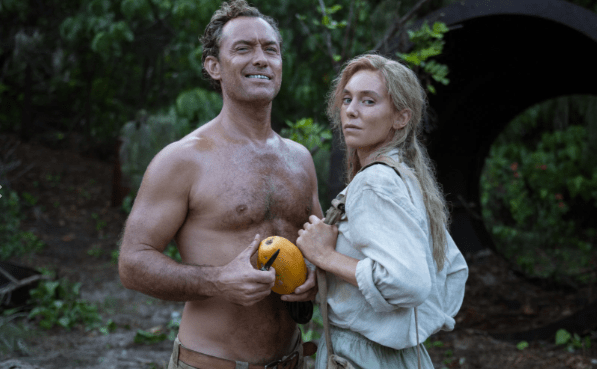
Based on the bizarre true story of Floreana Island in the Galápagos, pre-World War II, Eden follows Dr. Friedrich Ritter (Jude Law), a quack philosopher, and his pseudo-wife Dore Strauch (Vanessa Kirby), who flee Germany’s chaos for an isolated straw hut. They pen a manifesto, fancying themselves pioneers of a new, untainted existence. Their solitude is short-lived when a young German couple, Heinz and Margret Wittmer (Daniel Brühl and Sydney Sweeney), inspired by Ritter’s writings, drag their son to the island seeking a fresh start.
Ritter, enraged by the invasion of his “safe space,” schemes to maroon them in a deadly corner of the island, betting on their demise. Spoiler: they survive, carving out a livable nook.Enter Baroness Eloise Bosquet de Wagner Wehrborn (Ana de Armas), a flamboyant aristocrat with two lackeys in tow, dreaming of transforming Floreana into a five-star luxury resort. It’s a laughable plan—three people building a hotel with zero resources on a barren rock. Tensions boil as Ritter’s isolationism, the Wittmers’ resilience, and the Baroness’s hubris ignite a three-way battle for control of the island.

Betrayal, sabotage, and violence ensue, turning Eden into a survival thriller laced with dark irony.The film’s premise is its biggest flaw. The idea of a utopian experiment imploding under human flaws sounds compelling, but the execution veers into absurdity when taken at face value. Yet, there’s a swell of tension in the character clashes, and the real-life Floreana backdrop—where German expatriates fled on the eve of World War II—adds historical weight.
Eden exposes the wickedness of people who prioritize self-interest over empathy, a grim mirror to the cruelty brewing in Europe at the time. Jude Law’s Ritter starts as a lofty idealist but unravels as a delusional fraud, his philosophy crumbling under reality’s harsh glare. Vanessa Kirby’s Dore, battling multiple sclerosis through meditation instead of medicine, suffers predictably, her health deteriorating in a futile stand against modern care.

Sydney Sweeney’s Margret, alongside Brühl’s Heinz, embodies naive optimism, turning a hostile island into a makeshift home—lemons into lemonade, as the film suggests. Their grit is admirable, but their decision to follow Ritter’s manifesto to nowhere reeks of folly. Ana de Armas’ Baroness, meanwhile, weaponizes her charisma, manipulating her “army of simps” to sow chaos.
The dynamic—scheming women and spineless men—serves as a sharp character study of power and weakness, even if the story occasionally feels like a caricature.Sweeney delivers her best performance yet, grounding Margret as the film’s sole morally decent figure amid a cast of questionable-to-villainous characters. Law and Kirby are riveting, but their characters’ arrogance grates. De Armas chews the scenery, though her Baroness borders on cartoonish.
The film’s strength lies in its allegory: godless, isolated socialism—whether Ritter’s hermitage or the Baroness’s resort fantasy—inevitably collapses. It’s a lesson history keeps teaching, yet Eden’s characters learn it the hard way.Directed by Ron Howard, Eden boasts stunning Galápagos visuals, with stark landscapes amplifying the sense of isolation.

But the narrative stumbles, juggling too many perspectives without fully developing any. The pacing lags in the middle, and the climax feels more chaotic than cathartic. Still, the film’s tension and Sweeney’s standout turn make it a compelling, if flawed, case study of human nature.
Hollywood’s bait-and-switch marketing—selling sex appeal but delivering a morality tale—may frustrate some, but Eden’s grim irony lingers. It’s not a masterpiece, but it’s a cut above 2025’s usual dreck.
3/5




 Society Reviews
Leave a comment