
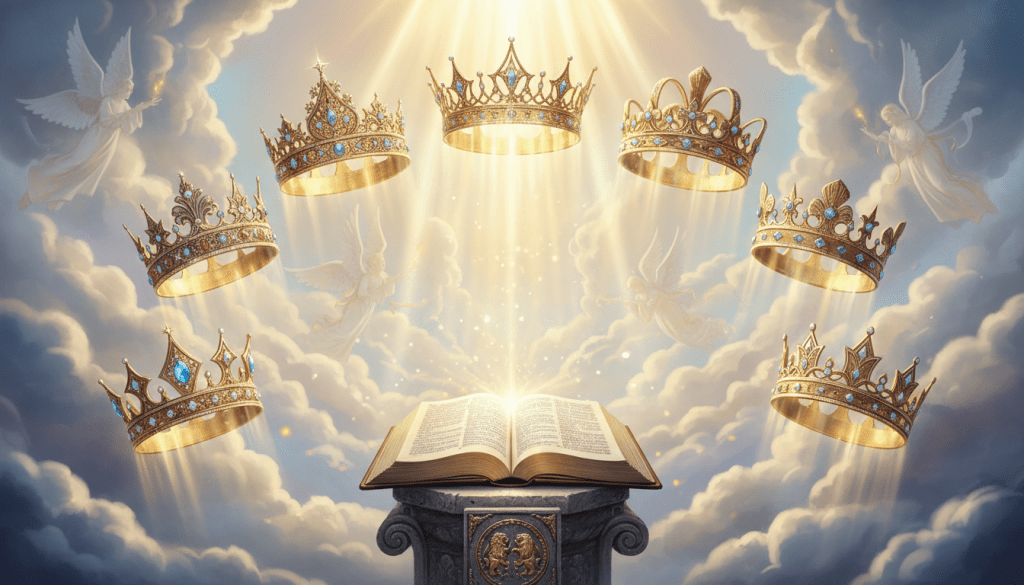
For many Christians, the promise of heaven is not merely about escaping judgment but about standing before Christ to receive tangible rewards for a life lived in obedience.

The Bible speaks repeatedly of “crowns” — not jeweled diadems of earthly royalty, but victor’s wreaths awarded at the judgment seat of Christ.
These are not prerequisites for salvation, which the Bible states is by grace through faith alone (Ephesians 2:8-9). Instead, they represent eternal compensation for faithful service after conversion. The apostle Paul writes in 2 Corinthians 5:10: “For we must all appear before the judgment seat of Christ; that every one may receive the things done in his body, according to that he hath done, whether it be good or bad.”
Though the Scriptures do not list the crowns in a single numbered roster, literal interpreters identify seven distinct references that faithful believers can pursue. Drawing directly from the King James text, these rewards underscore a recurring biblical theme: earthly choices carry heavenly weight.

The concept echoes the ancient Olympic games, where athletes competed for fading laurel wreaths. Paul makes the parallel explicit in 1 Corinthians 9:24-27, contrasting corruptible crowns with the incorruptible one available to Christians. In an era when many believers focus on temporal success, these passages invite a recalibration — a reminder that history’s final ledger will be written in eternity.
1. The Incorruptible Crown: Mastery Over the Flesh
The first crown appears in Paul’s letter to the Corinthian church. “And every man that striveth for the mastery is temperate in all things,” he writes. “Now they do it to obtain a corruptible crown; but we an incorruptible” (1 Corinthians 9:25).
To obtain it, believers must exercise strict self-discipline. Paul describes bringing his body “into subjection” lest he become a castaway after preaching to others. Literal readers see this as a call to temperate living — controlling appetites, habits and impulses through the Holy Ghost’s power. It is not asceticism for its own sake but purposeful restraint so that the gospel message remains credible. Modern application, according to many pastors, includes everything from sexual purity to financial stewardship and digital discipline. The reward is an unfading crown of victory that will never tarnish.

2. The Crown of Rejoicing: The Soul-Winner’s Prize
Paul again provides the language in his first letter to the Thessalonians. “For what is our hope, or joy, or crown of rejoicing? Are not even ye in the presence of our Lord Jesus Christ at his coming?” (1 Thessalonians 2:19).
This crown belongs to those who lead others to faith. The souls they help bring into the kingdom become their “crown of rejoicing.” Philippians 4:1 echoes the same imagery, calling converts “my joy and crown.” Obtaining it requires active gospel witness — not merely passive belief but intentional sharing, prayer and discipleship. In a secular age, literal interpreters emphasize personal evangelism and missions work as the pathway.
The joy, Scripture suggests, will be multiplied when those converts stand together at Christ’s return.

3. The Crown of Righteousness: For Those Who Love His Appearing
Near the end of his life, Paul wrote to Timothy: “I have fought a good fight, I have finished my course, I have kept the faith: Henceforth there is laid up for me a crown of righteousness, which the Lord, the righteous judge, shall give me at that day: and not to me only, but unto all them also that love his appearing” (2 Timothy 4:7-8).
The qualifier is clear: this crown is for every believer who lives in eager anticipation of Christ’s second coming. It is not reserved for apostles but promised to “all them also” who love His appearing. Literal application means rejecting cynicism about prophecy, studying the signs of the times and ordering daily life with eternity in view. Righteous living flows from that hope. Scholars note that this crown underscores personal holiness and doctrinal fidelity in the face of cultural pressure.
4. The Crown of Glory: Reward for Faithful Shepherds
The apostle Peter addresses church leaders directly: “Feed the flock of God which is among you, taking the oversight thereof, not by constraint, but willingly; not for filthy lucre, but of a ready mind; Neither as being lords over God’s heritage, but being ensamples to the flock. And when the chief Shepherd shall appear, ye shall receive a crown of glory that fadeth not away” (1 Peter 5:2-4).
Pastors, elders and spiritual mentors who serve humbly and sacrificially qualify. The crown is not for domineering or money-driven ministry but for willing, exemplary oversight. Many extend the principle beyond vocational clergy: any believer who mentors, teaches or guides others in the faith partakes in this reward. The emphasis remains on character — serving “of a ready mind” under Christ, the Chief Shepherd.

5. The Crown of Life: Endurance Through Trial
James offers straightforward instruction: “Blessed is the man that endureth temptation: for when he is tried, he shall receive the crown of life, which the Lord hath promised to them that love him” (James 1:12).
Jesus Himself repeats the promise to the suffering church at Smyrna: “Be thou faithful unto death, and I will give thee a crown of life” (Revelation 2:10). This crown is for those who love the Lord supremely and remain steadfast under persecution or temptation. It is not automatic; it requires active endurance. In regions where Christians face imprisonment or martyrdom today, the passage carries particular weight.
Even in comfortable Western contexts, literal readers apply it to resisting cultural compromise, maintaining doctrinal purity and refusing to deny Christ when convenient.
6. The Crown of the Overcomer: Holding Fast
To the church at Philadelphia, Jesus warns: “Behold, I come quickly: hold that fast which thou hast, that no man take thy crown” (Revelation 3:11). Overcomers — defined elsewhere as those who conquer by faith in Christ (1 John 5:4-5) — must guard their reward vigilantly.
This crown is obtained by perseverance, refusing false teaching and clinging to Scripture without compromise. The language of “holding fast” implies active defense of truth. Many interpreters see it as a cautionary reward: possible to lose through negligence or apostasy, yet secure for the faithful who overcome.
7. The Crowns of Gold: The Worshipper’s Reward
In Revelation’s heavenly vision, twenty-four elders — widely understood by literalists as representing the redeemed church — sit enthroned “clothed in white raiment; and they had on their heads crowns of gold” (Revelation 4:4). Later they cast those crowns before the throne, declaring, “Thou art worthy, O Lord” (Revelation 4:10-11). These gold crowns symbolize the victory and authority granted to every overcomer.
They are obtained through a lifetime of worshipful obedience that culminates in total surrender. The act of casting them at Jesus’ feet illustrates the ultimate purpose of all rewards: magnifying Christ alone. Believers who live with that posture — acknowledging that every victory is His — qualify for such honor.
Across all seven crowns, the Bible’s standard remains consistent. Rewards are not earned by works for salvation but by grace-empowered faithfulness afterward. The apostle John warns in 2 John 1:8, “Look to yourselves, that we lose not those things which we have wrought, but that we receive a full reward.”

In a culture obsessed with temporal legacy — social media followers, financial portfolios, career accolades — the biblical doctrine of crowns offers a counter-narrative. It reframes daily decisions as investments in eternity.
Evangelical pastors frequently cite these passages in sermons on stewardship, urging congregants to “lay up for yourselves treasures in heaven” (Matthew 6:20). Critics sometimes dismiss the teaching as legalistic, yet literal interpreters respond that Scripture distinguishes clearly between salvation (a free gift) and rewards (earned compensation).
The judgment seat of Christ is not punitive for believers but evaluative — a moment of accountability and celebration. Ultimately, the crowns point believers back to the Giver. Whether an incorruptible wreath for self-control, a rejoicing garland for souls won, or golden symbols of worship, each reward will be laid at the feet of the One who purchased redemption. In the words of the elders themselves: “Thou art worthy, O Lord, to receive glory and honour and power.”

For Christians who take the Bible at its word, these seven crowns are more than metaphor. They are promised realities — incentives to run the race, finish the course and hear the Master say, “Well done, thou good and faithful servant” (Matthew 25:21). In an uncertain world, that eternal perspective remains a source of both comfort and conviction.
Don’t forget to Subscribe for Updates. Also, Follow Us at Society-Reviews, YouTube, Instagram, Twitter, Odysee, Rumble, and Twitch



 Society Reviews
Leave a comment