
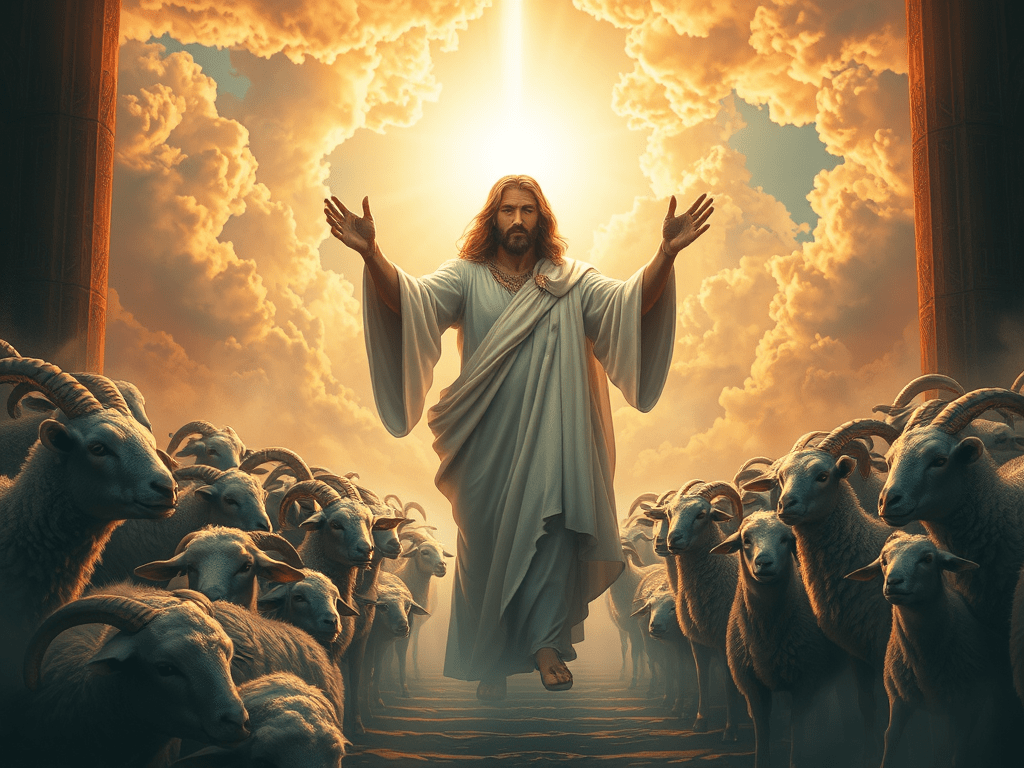
What Happens to Tribulation Survivors When Christ Returns?
The parable (more accurately, the prophetic description) of the Sheep and the Goats is the final portion of the Olivet Discourse, the longest private teaching Jesus ever gave His disciples. Delivered on the Mount of Olives two days before the crucifixion (Matt. 24:3), it answers the question, “What shall be the sign of thy coming, and of the end of the world [age]?”
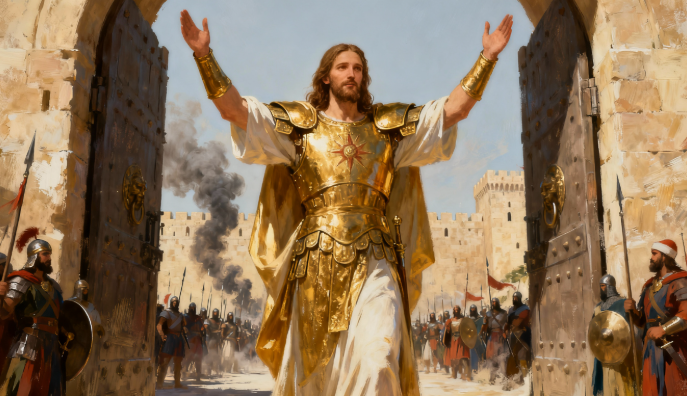
After speaking of the abomination of desolation, the Great Tribulation, and His visible return in glory (Matt. 24:15–31), Jesus immediately describes the very first official act He will perform when His feet touch the Mount of Olives again: the judgment of the living Gentile nations.
This is not the Great White Throne judgment of Revelation 20 (which occurs 1,000 years later, after the Millennium, and judges only the resurrected dead). This is a judgment of living survivors who are still in natural bodies at the end of the seven-year Tribulation.
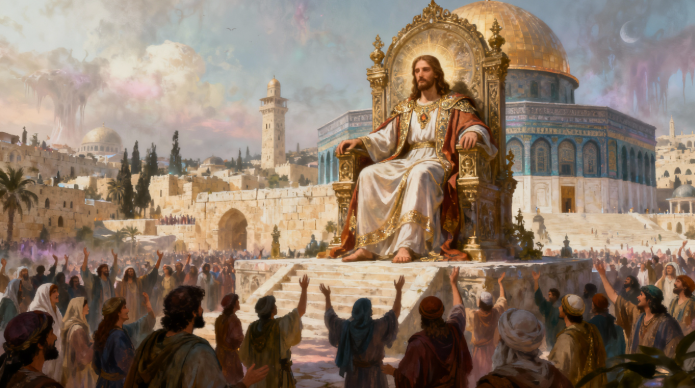
Verse 31:“When the Son of man shall come in his glory, and all the holy angels with him, then shall he sit upon the throne of his glory:” This is the Second Coming itself (Rev. 19:11–16; Zech. 14:4). Christ returns publicly, visibly, with millions of angels, and immediately sets up His glorious throne on earth (almost certainly in Jerusalem; cf. Isa. 2:2–4; Zech. 14:9, 16–17). The timing is explicit: this happens the very moment He returns at the close of the Tribulation.
Verse 32: “And before him shall be gathered all nations: and he shall separate them one from another, as a shepherd divideth his sheep from the goats:”“ All nations” is πάντα τὰ ἔθνη – every Gentile ethnic group still existing on earth. The Jews are not in view here; Israel has already been regathered and judged separately in the moment Christ returns (Ezek. 20:33–38; Mal. 3:2–5; Matt. 24:31).
Only living Gentiles who survived the plagues, wars, and martyrdom of the Tribulation are gathered before the throne. The separation is instantaneous and infallible. Sheep (believers) go to the right – the place of blessing in Hebrew thought. Goats (unbelievers) go to the left – the place of cursing.
Verse 33: “And he shall set the sheep on his right hand, but the goats on the left.” This is not a parable in the usual sense; it is a literal future event described with a shepherding illustration. Palestinian shepherds commonly separated sheep and goats at night because goats needed more warmth. The picture is familiar, but the reality is judicial and final.

Verse 34: “Then shall the King say unto them on his right hand, Come, ye blessed of my Father, inherit the kingdom prepared for you from the foundation of the world:” The “King” is the Lord Jesus in His millennial reign. The kingdom is the long-promised 1,000-year earthly reign (Rev. 20:4–6). These sheep inherit it in their natural bodies and become the nations they represent will be blessed under Israel (Zech. 8:23; Isa. 19:23–25).
Verses 35–36: “For I was an hungred, and ye gave me meat: I was thirsty, and ye gave me drink: I was a stranger, and ye took me in: Naked, and ye clothed me: I was sick, and ye visited me: I was in prison, and ye came unto me.”The King gives the reason for their blessing: concrete, costly acts of mercy performed to persecuted believers during the Tribulation.
Verses 37–39: “Then shall the righteous answer him, saying, Lord, when saw we thee an hungred…?”The sheep are genuinely surprised. Their works were not done for reward; they simply loved the Lord by loving His people.

Verse 40“And the King shall answer and say unto them, Verily I say unto you, Inasmuch as ye have done it unto one of the least of these my brethren, ye have done it unto me.” Here is the key interpretive phrase: “these my brethren” (τῶν ἀδελφῶν μου τῶν ἐλαχίστων). Throughout Matthew, the Lord’s “brethren” are the Jewish people or Jewish disciples (Matt. 12:46–50; 28:10). In the Tribulation context, the “least of these my brethren” are the 144,000 sealed Israelites and the Jewish remnant who are hated “of all nations for my name’s sake” (Matt. 24:9) and who flee into the wilderness (Rev. 12:6, 14). They will be starving, naked, sick, and imprisoned under Antichrist’s persecution. Any Gentile who feeds, clothes, visits, or hides a believing Jew is counted as having done it to Christ Himself.
Verses 41–43: “Then shall he say also unto them on the left hand, Depart from me, ye cursed, into everlasting fire, prepared for the devil and his angels: For I was an hungred, and ye gave me no meat….”The goats are condemned for the same reason – but in the negative. They did nothing. They refused to help. Many actively betrayed, persecuted, or handed Jews over to death. Their omission is treated as active hostility.
Verse 44: “Then shall they also answer him, saying, Lord, when saw we thee…?”The goats protest, but their protest only confirms guilt. They saw the need and chose indifference or opposition.

Verse 45: “Then shall he answer them, saying, Verily I say unto you, Inasmuch as ye did it not to one of the least of these, ye did it not to me.”Neutrality is impossible. Failing to aid Christ’s brethren is counted as refusing aid to Christ Himself.
Verse 46: “And these shall go away into everlasting punishment: but the righteous into life eternal [aionios].”Two destinies, no third option:
- The sheep (righteous by faith, proven by works toward Israel) enter the Millennial Kingdom in their natural bodies and enjoy “age-lasting life” throughout the 1,000 years and beyond.
- The goats are removed immediately and cast into the same everlasting fire awaiting the devil and his angels (Rev. 20:10, 15). They do not wait for the Great White Throne; their judgment is executed at once.

What Happens to Every Category of Tribulation Survivor?
- Gentiles who took the mark of the beast
Already eternally damned (Rev. 14:9–11). Most are destroyed by the seven last plagues or by Christ’s sword at Armageddon (Rev. 19:21). Any theoretical survivors are executed at this judgment. - Gentiles who refused the mark and actively helped Israel/Jewish believers
Declared “sheep,” blessed, and allowed to enter the Kingdom in natural bodies. Their nations will go up yearly to worship in Jerusalem (Zech. 14:16). - Gentiles who refused the mark and refused to help Israel (the vast majority)
Declared “goats” and sent immediately into everlasting fire. Zechariah 14:12–19 shows that some soldiers from attacking nations survive the initial plague when Christ returns, only to stand in this judgment and be removed. - Tribulation saints (both Jewish and Gentile) who were martyred
Already resurrected at the pre-millennial resurrection (Rev. 20:4–6) and reigning with Christ. They do not appear in this judgment. - The nation of Israel
Already regathered and judged in the wilderness (Ezek. 20:35–38). The believing remnant enters the Kingdom; the rebels are purged out.
Conclusion
The Sheep and Goats judgment is the divine dividing line that determines who populates the Millennial earth. It is not a judgment of the church (already raptured), not a judgment of the resurrected dead (that comes later), and not a judgment of Israel as a nation (already accomplished). It is exclusively the judgment of living Gentiles based on one criterion: how did you treat My brethren – the persecuted Jewish remnant – during the Tribulation?
In that day there will be no successful “neutral” survivors. Every person still alive when Christ returns will either be welcomed as a blessed sheep entering the Kingdom or removed as a cursed goat entering everlasting fire. The King has spoken it, and the King James Bible leaves no room for any other outcome.
Don’t forget to Subscribe for Updates. Also, Follow Us at Society-Reviews, YouTube, Instagram, Twitter, Odysee, Rumble, and Twitch




 Society Reviews
Leave a comment