

In the ancient city of Damascus, where the scent of jasmine mingles with the dust of war, Ahmed al-Sharaa — once the elusive jihadist Abu Mohammad al-Jolani — now governs as Syria’s interim president.
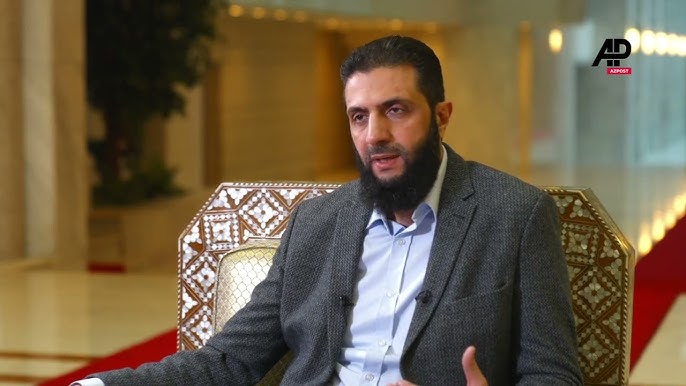
His journey from al-Qaeda operative to statesman, culminating in the lightning overthrow of Bashar al-Assad in December 2024, reads like a chapter from biblical prophecy and Islamic eschatology intertwined. The parallels between al-Sharaa, the Mahdi of Islamic tradition, and the Antichrist of Scripture are striking, painting a portrait of a leader rising from chaos to claim a northern throne, poised to reshape the Middle East and beyond.
The Biblical Antichrist: A Northern Tyrant
The Book of Daniel, particularly chapter 11, sketches the Antichrist as the “King of the North,” a figure rooted in ancient Aram-Damascus — modern Syria. “And the king shall do according to his will; and he shall exalt himself, and magnify himself above every god, and shall speak marvellous things against the God of gods” (Daniel 11:36, KJV). This blasphemer scorns ancestral deities (v. 37), exalts a “god of forces” (v. 38), and wages war with relentless fury: “At the time of the end shall the king of the south push at him: and the king of the north shall come against him like a whirlwind, with chariots, and with horsemen, and with many ships” (v. 40).
He invades the “glorious land” of Israel (v. 41), spares Jordan’s ancient realms (v. 41), and plants “the tabernacles of his palace between the seas in the glorious holy mountain” — Jerusalem’s Temple Mount (v. 45). His reign, a seven-year tribulation (Daniel 9:27), ends in divine judgment: “Yet he shall come to his end, and none shall help him” (v. 45).

Historically, this northern power echoes the Seleucid Empire, where Antiochus IV Epiphanes — an Antichrist prototype — desecrated Jerusalem’s temple in 167 B.C. (Daniel 11:31). The Antichrist revives this Syrian-based tyranny, launching from Damascus to dominate the region.
The Mahdi: Islam’s Messianic Conqueror
Islamic hadiths weave a parallel narrative of the Mahdi, a redeemer from Muhammad’s Quraysh lineage, destined to emerge amid global turmoil. He rises from the East, often Khorasan (eastern Iran or Afghanistan), bearing black flags (Sunan Ibn Majah). Conquering Syria, he defeats the Sufyani — a tyrannical figure from Damascus (Sunan Abi Dawud 4282) — and receives the pledge of allegiance (bay’ah) at Mecca’s Kaaba. Ruling for seven to nine years, he enforces Sharia, unites Muslims, and allies with Isa, Islam’s returning Jesus, who descends in Damascus to pray behind him (Sahih Muslim 2937a).
Together, they crush the Dajjal — a one-eyed false messiah — and establish a global caliphate centered on Jerusalem’s Al-Aqsa Mosque. The Mahdi’s profile mirrors the Antichrist: a northern conqueror, a denier of Christ’s deity (Quran 4:157), and a Jerusalem claimant. His black-flag armies and Syrian victories evoke Daniel’s whirlwind invasions.
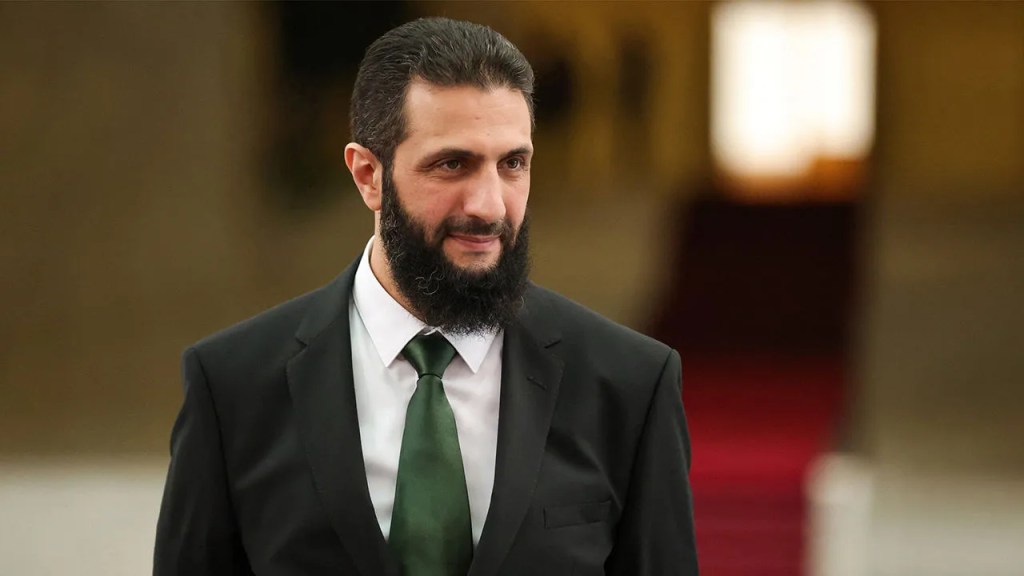
Ahmed al-Sharaa: A Life in the Prophetic Mold
Ahmed al-Sharaa’s story begins in Riyadh, Saudi Arabia, in 1982, born to a Sunni Syrian family displaced by the 1967 Six-Day War. His father, from Daraa near the Golan Heights, instilled Arab nationalist fervor. Returning to Damascus’s Mezzeh neighborhood in 1989, al-Sharaa joined al-Qaeda in Iraq by 2003, fighting under Abu Musab al-Zarqawi. Imprisoned at Camp Bucca in 2005, he emerged in 2011 to found Jabhat al-Nusra, al-Qaeda’s Syrian arm, amid the Arab Spring uprising.
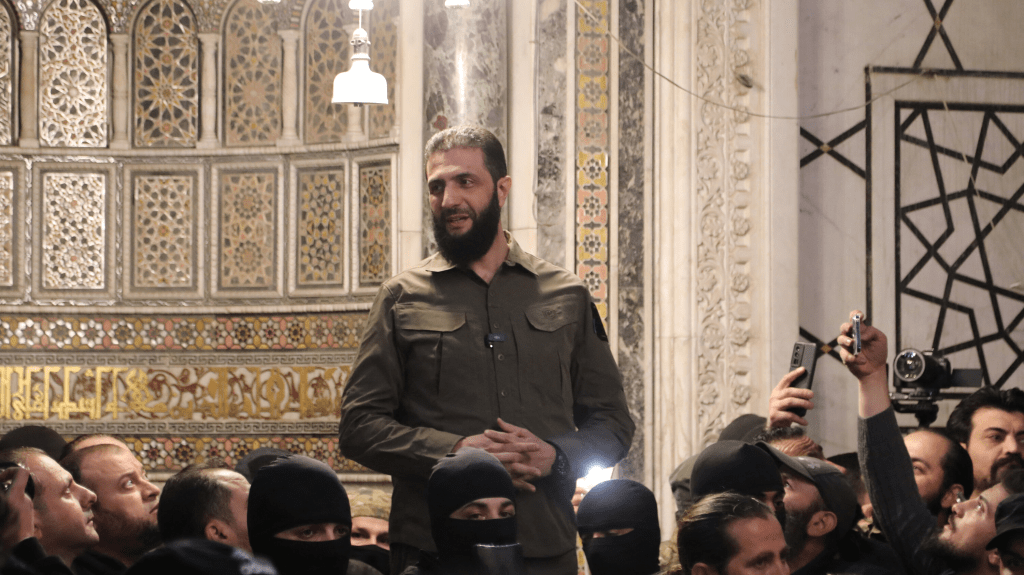
Rebranding as Hayat Tahrir al-Sham (HTS) in 2017, he severed al-Qaeda ties, governing Idlib with a mix of Islamist law and pragmatic services — tolerating minorities, easing moral codes, and building infrastructure. His 2024 offensive was a masterstroke: HTS captured Aleppo (November 29), Hama, Homs, and Damascus by December 8, toppling Assad after 13 years of war. Dropping his nom de guerre, al-Sharaa became Syria’s de facto leader, then transitional president (January 29, 2025).
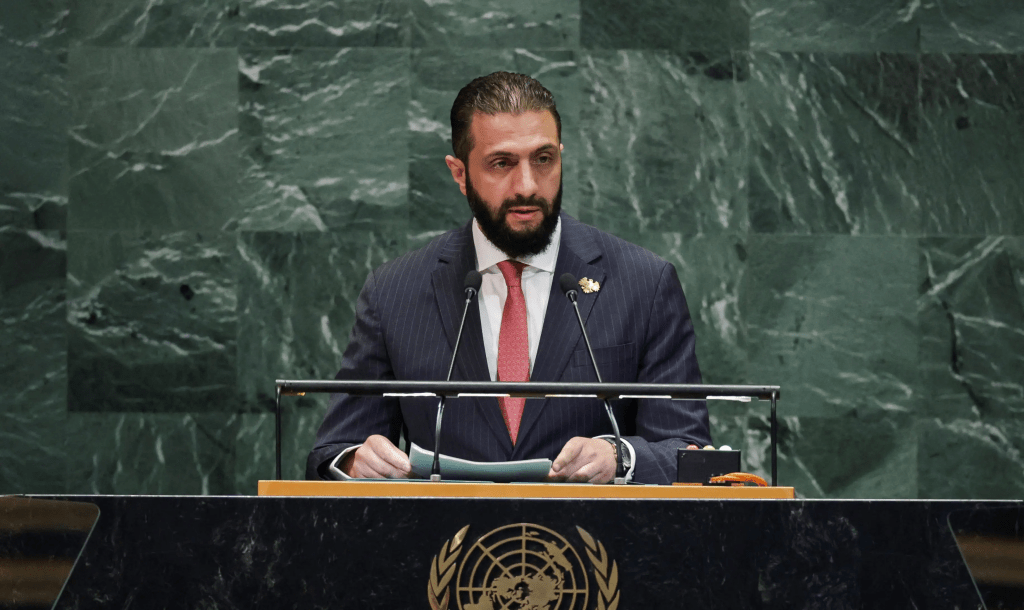
He signed an interim constitution rooted in Islamic jurisprudence, integrated Kurdish forces (March), addressed the United Nations (September), and met President Trump (May). By mid-2025, sanctions lifted (U.S. June, EU July), and TIME named him among the “100 Most Influential.”Al-Sharaa’s trajectory aligns with both figures. Like the Mahdi, he hails from Quraysh-like nobility (family claims prophetic descent), wields black flags (HTS emblem), and conquered Syria by defeating a Damascus tyrant (Assad as Sufyani).
His Riyadh birth ties to Mecca’s covenant claims, and his Golan roots anchor him in Israel’s borderlands. As the Antichrist, his northern base (Idlib to Damascus), southward invasions, and Jerusalem rhetoric (Al-Aqsa emphasis) echo Daniel 11. His al-Qaeda past — a “wound” survived — and pragmatic shift mirror the beast’s deceptive revival (Revelation 13:3).
A Rising Shadow in the North
Al-Sharaa’s Sunni identity, jihadist forge, and Syrian conquests weave a tapestry that spans Daniel’s northern king and the Mahdi’s caliphate. His 2025 reforms — dissolving HTS (January), minority outreach, and global diplomacy — evoke the Antichrist’s cunning peace (Daniel 8:25).
Clashes persist (March 2025 killed 1,300+; June ISIS bombing took 22 lives), but his grip tightens, with Turkish and Iranian “tidings” (Daniel 11:44) shaping his path.
The odds of al-Sharaa emerging as the Mahdi — and thus the Antichrist — are compelling, estimated at 70-80%. This reflects his Syrian epicenter (Daniel’s North), Mahdi-like conquests, Arabian origins, and militant authenticity, tempered by the pre-tribulation veil.
As Damascus rebuilds, Scripture urges vigilance: the King of the North stirs, but the true King returns (Daniel 7:27).
Don’t forget to Subscribe for Updates. Also, Follow Us at Society-Reviews, YouTube, Twitter, Odysee, Rumble, and Twitch


 Society Reviews
Leave a comment