

In the labyrinthine streets of this ancient city, where the Umayyad Mosque’s minarets pierce a sky often choked with dust, Syria’s turbulent history feels like a prelude to something larger.

Once the beating heart of the Seleucid Empire and a cradle of early Christianity, Damascus has endured invasions, earthquakes, and civil strife. But as the world grapples with the aftershocks of Syria’s dramatic upheaval in late 2024 — the swift overthrow of Bashar al-Assad’s regime and the fragile transition to a caretaker government — biblical scholars are turning anew to Scripture’s ominous prophecies about this land.
Verses scattered across the Old Testament, from Amos to Zechariah, paint Syria not as a footnote in end-times lore but as a central stage for the rise of the Antichrist and the cataclysmic events preceding Christ’s return.
These prophecies, written millennia ago, resonate with uncanny precision amid Syria’s recent chaos. The fall of Assad in December 2024, after a lightning offensive by opposition forces led by Hayat Tahrir al-Sham (HTS), marked the end of over five decades of Assad family rule. By January 2025, HTS leader Ahmed al-Sharaa had assumed de facto control, transitioning to a transitional government by March.

Yet stability remains elusive: Western Syria clashes erupted in March 2025, killing over 1,300 in 72 hours, including massacres of Alawite civilians by pro-Assad loyalists and retaliatory strikes by the new regime. By June, Islamic State remnants launched a suicide attack on a Damascus church, killing 22. October brought further unrest, with President al-Sharaa removing Assad-era holidays and Syria recognizing Kosovo’s independence — symbolic gestures amid ongoing Israeli airstrikes (over 255 since October 2023) and Turkish-backed operations against Kurdish forces.
As humanitarian needs soar — with 16.7 million Syrians requiring aid in 2024, per the United Nations — these events evoke the biblical portrait of a northern kingdom in turmoil, poised for a final, apocalyptic role. Drawing on key verses — Amos 1:3–5, Isaiah 17, Jeremiah 49:23–29, Zechariah 9:1–8, and Daniel 11:36–45 — the Bible positions Syria (ancient Aram or Aram-Damascus) as a perennial adversary to Israel, destined for devastation and revival under a blasphemous ruler: the Antichrist.
The Ancient Foe: Syria’s Biblical Backstory
Syria enters Scripture as Aram, a Semitic kingdom north of Israel, centered on Damascus — the world’s oldest continuously inhabited city. From the 10th century B.C., Aramean kings like Hazael ravaged Israel (2 Kings 8:12), earning divine condemnation. The prophet Elisha foretold this enmity, and by 732 B.C., Assyria’s Tiglath-Pileser III deported Damascus’s population to Kir (2 Kings 16:9), fulfilling early judgments.

Under Alexander the Great’s successors, Syria became the Seleucid Empire (312–63 B.C.), with Antioch as its capital. Antiochus IV Epiphanes — a historical Antichrist archetype — desecrated Jerusalem’s temple in 167 B.C., sacrificing pigs on its altar and banning circumcision (1 Maccabees 1:44–50). This “abomination of desolation” (Daniel 11:31) prefigures the end-times tyrant. Rome later absorbed Syria, but its legacy as a “northern power” endures in prophecy.
Amos 1:3–5: The Breaking of Damascus’s Gates
The prophet Amos, writing around 760 B.C., thunders against Syria’s cruelty: “For three transgressions of Damascus, and for four, I will not turn away the punishment thereof; because they have threshed Gilead with threshing instruments of iron” (Amos 1:3). Gilead, east of the Jordan, suffered brutal Aramean incursions. God’s verdict: “I will break also the bar of the gate of Damascus, and cut off the inhabitant from the plain of Aven, and him that holdeth the sceptre from the house of Eden: and the people of Syria shall go into captivity unto Kir, saith the Lord” (v. 5).
The “bar of the gate” symbolizes military might; its breaking foretells collapse. Historically, Assyria sacked Damascus in 732 B.C. But the prophecy’s totality — deportation to Kir — remains unfulfilled, pointing to an end-times reckoning. In 2024–2025, Syria’s gates “broke” metaphorically: HTS’s November 2024 offensive captured Aleppo and Hama, fracturing Assad’s defenses. By December, Damascus fell, exiling Assad to Moscow. Yet clashes persist — over 2,644 killed in March 2025 alone — echoing Amos’s unquenched fire.
Jeremiah 49:23–29: Confusion in Hamath and the Fire on Damascus

Jeremiah’s oracle against Damascus evokes dread: “Concerning Damascus. Hamath is confounded, and Arpad: for they have heard evil tidings: they are fainthearted; there is sorrow on the sea; it cannot be quiet” (Jeremiah 49:23). Hamath (modern Hama) and Arpad (Tell Rifaat) tremble at rumors of invasion. “Damascus is waxed feeble, and turneth herself to flee, and fear hath seized on her: anguish and sorrows have taken her, as a woman in travail” (v. 24).
God promises fire: “I will kindle a fire in the wall of Damascus, and it shall consume the palaces of Ben-hadad” (v. 27).Ben-hadad, Aramean kings who warred with Israel, represents enduring tyranny. The “sorrow on the sea” may allude to Mediterranean incursions. Historically, this partially fulfilled in Assyrian and Babylonian sacks. Today, it mirrors Syria’s 2024–2025 agony: HTS’s November offensive sowed “evil tidings” in Aleppo, killing thousands. U.S. strikes on Iranian militias (November 11, 2024) and ISIS camps (October 28) kindled literal fires.
By March 2025, Western Syria clashes displaced 900,000, with anguish akin to “a woman in travail.” Jeremiah’s fire — unextinguished — awaits a final conflagration, perhaps nuclear, aligning with Damascus’s prophesied ruin.
Zechariah 9:1–8: The Burden Against the North

Zechariah’s post-exilic vision (520 B.C.) burdens Hadrach and Damascus: “The burden of the word of the Lord in the land of Hadrach, and Damascus shall be the rest thereof: when the eyes of man, as of all the tribes of Israel, shall be toward the Lord” (Zechariah 9:1). Judgment sweeps from Hadrach (near Aleppo) to Hamath, Tyre, and Gaza. “Ashkelon shall see it, and fear; Gaza also shall see it, and be very sorrowful… And I will encamp about mine house because of the army” (v. 5, 8).This northward-to-southward progression halts at Israel’s border — God encamps protectively.
Historically, it echoes Alexander’s conquests (333 B.C.), but the “army” implies a final northern horde. In 2024–2025, Turkish-backed Syrian National Army operations in northern Syria (November 2024) and Israeli strikes (255 since October 2023) evoke this sweep. HTS’s advance southward toward Damascus fulfills the “sorrowful” gaze of Gaza and Ashkelon amid regional wars. Zechariah’s encampment promises divine intervention when the Antichrist’s forces — a revived northern power — threaten Jerusalem.
Isaiah 17: The Oracle of Damascus’s Destruction
Isaiah’s prophecy stands stark: “The burden of Damascus. Behold, Damascus is taken away from being a city, and it shall be a ruinous heap” (Isaiah 17:1). The “fortified cities of Israel” become desolate (v. 9), and “in that day shall a man look to his Maker” (v. 7). Yet Ephraim’s glory wanes (v. 3–4), and reapers gather (v. 5).This “in that day” signals the Day of the Lord — tribulation.
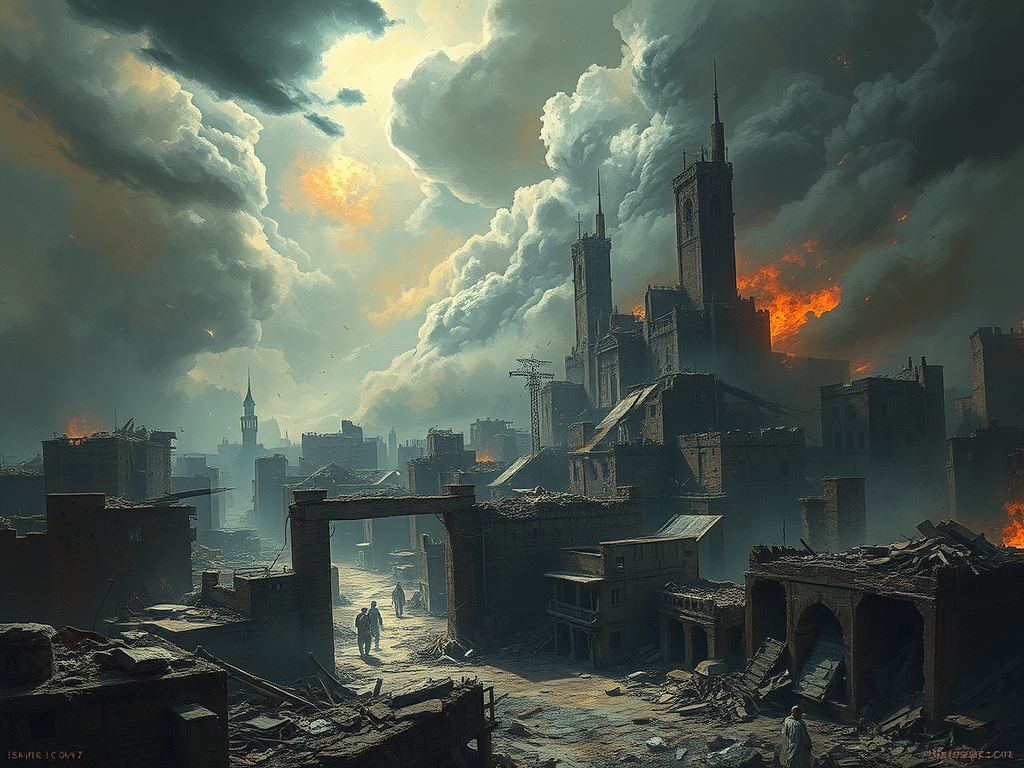
Damascus’s annihilation is unique: no other capital is so utterly erased. Historically, partial in 732 B.C. and 605 B.C. Today, Damascus endures, but 2024–2025’s fall — HTS’s December capture amid airstrikes and clashes — sets the stage. The city’s “ruinous heap” may come via escalated conflict, perhaps a chemical weapons strike (OPCW reports ongoing concerns) or Israeli preemption. Israel’s “waning glory” ties to tribulation persecution (Daniel 7:21), but ultimate turning to God (v. 7) foreshadows Zechariah 12:10.
Daniel 11:36–45: The King of the North and the Glorious Land
Daniel’s vision culminates in the “time of the end” (v. 40): “And the king shall do according to his will; and he shall exalt himself, and magnify himself above every god… neither shall he regard the God of his fathers” (v. 36). This blasphemer — the Antichrist — honors a “god of forces” (v. 38), invades the “glorious land” (Israel, v. 41), and plants “the tabernacles of his palace between the seas in the glorious holy mountain” (Jerusalem, v. 45).The “king of the North” (v. 40) clashes with the “king of the South,” then troubles from “east and north” (v. 44).
Historically, this fits Antiochus IV (Seleucid Syria). Eschatologically, it revives a Syrian-based power. The Antichrist’s disregard for “the God of his fathers” (v. 37) echoes Islam’s denial of Yahweh (Quran 5:75). In 2024–2025, HTS’s northern origins (Idlib) and conquests southward mirror this dynamic, with Iranian “tidings from the east” (U.S. strikes on militias) and Turkish “north” interventions.
Syria’s Recent Turmoil: A Prophetic Prelude?

Syria’s prophecies converge on the Antichrist: a northern king (Daniel 11) reviving Seleucid blasphemy, launching from Damascus’s ruins (Isaiah 17) with Arab allies (Jeremiah 49). Amos’s broken gates and Zechariah’s halted army frame his invasion of Israel, culminating in Jerusalem’s siege (Daniel 11:45). The pre-tribulation rapture (1 Thessalonians 4:16–17) precedes this, but tribulation saints face the test.
As Syria transitions — HTS integrating SDF by March 2025, sanctions lifting — the stage is set. Will Damascus fall utterly? Will a “king of the North” exalt himself? Scripture whispers: yes. And in that day, eyes will turn to the Maker (Isaiah 17:7), awaiting the true King.
Don’t forget to Subscribe for Updates. Also, Follow Us at Society-Reviews, YouTube, Twitter, Odysee, Rumble, and Twitch



 Society Reviews
Leave a comment