

At the heart of Islam’s most sacred city stands a black-draped cube known as the Kaaba, a structure toward which 1.8 billion Muslims turn five times daily in prayer.
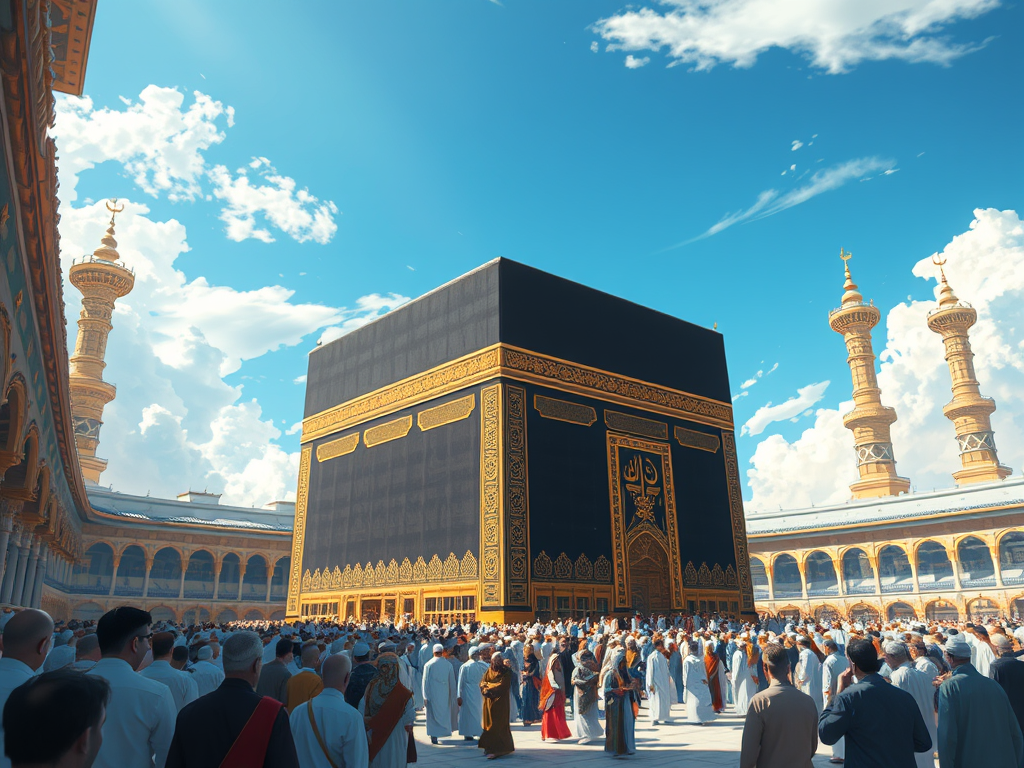
For centuries, it has been revered as the “House of God,” the focal point of the Hajj pilgrimage, and the geographical center of Islamic devotion. Yet a growing body of biblical scholarship, grounded in a literal reading of the Book of Revelation, proposes a startling reinterpretation: the Kaaba may fulfill the prophecy of the “image of the beast” described in Revelation 13 — a global object of enforced worship that deceives the world and demands allegiance under penalty of death.
This is not a fringe conspiracy but a serious eschatological hypothesis that integrates historical archaeology, Islamic tradition, and a pre-tribulation rapture framework. It aligns the Kaaba with the Antichrist system of the end times, where Satan — the Dragon of Revelation 12:9 — is worshipped through a structure already embedded in the daily lives of nearly a quarter of humanity.
The Biblical Prophecy: A Speaking, Enforced Image
The Book of Revelation, written in the first century A.D., describes a seven-year period of tribulation marked by the rise of two beasts. The first, emerging from the sea (Revelation 13:1–10), is the Antichrist — a political and military ruler who blasphemes God, survives a fatal wound, and dominates the world. The second, rising from the earth (Revelation 13:11–18), is the False Prophet, a religious figure who performs miracles and compels global worship of the Antichrist through an “image.”
“And he deceiveth them that dwell on the earth by the means of those miracles which he had power to do in the sight of the beast,” the text reads, “saying to them that dwell on the earth, that they should make an image to the beast… And he had power to give life unto the image of the beast, that the image of the beast should both speak, and cause that as many as would not worship the image of the beast should be killed” (Revelation 13:14–15, King James Version).
This image is not merely symbolic. It is animated — given “breath” (Greek: pneuma) — and enforces a mark without which “no man might buy or sell” (13:17). Those who worship it face eternal judgment (Revelation 14:9–11).
The Kaaba: A Preexisting Global Worship System
No structure on earth matches the Kaaba’s scale of enforced, visible devotion. Every practicing Muslim, regardless of location, must face the Kaaba (qibla) during the five daily prayers (salat). This act — forehead to the ground, right hand raised in testimony — is a physical, repeatable gesture of submission performed 9 billion times daily across the planet.
The Kaaba is not a passive symbol. It is the axis of Islamic ritual:
- Tawaf: Pilgrims circumambulate it seven times.
- Hajj: An annual obligation for those able, drawing millions.
- Black Stone: Embedded in the eastern corner, it is kissed or touched, believed to erase sins (Sahih Muslim 1720).

Islamic tradition itself endows the Black Stone with eschatological significance. The eighth-century scholar Ibn Hajar al-Asqalani records a saying of the Prophet Muhammad: “The Black Stone is Allah’s right hand on earth.” Another hadith in Sahih al-Bukhari (1597) states: “By Allah, Allah will raise it on the Day of Resurrection with two eyes with which it will see and a tongue with which it will speak, and it will testify for those who touched it in truth.
”This is not metaphor. In Islamic eschatology, the Black Stone will speak — a direct parallel to Revelation 13:15.
Historical Origins: A Baal Shrine Repurposed
Archaeological and textual evidence reveals the Kaaba’s pre-Islamic identity as a pagan shrine. The eighth-century Book of Idols by Ibn al-Kalbi documents that the Kaaba housed 360 idols, with Hubal — a moon-god statue — as the chief deity, positioned above the Black Stone. The Quraysh tribe, custodians of the shrine and ancestors of Muhammad, performed arrow divination before Hubal.
Greek historians Herodotus and Diodorus Siculus describe Arabian tribes worshipping a black stone in a cube temple dedicated to Baal or Bel, the Babylonian moon-god. The name “Hubal” derives from the same Semitic root as “Baal” — meaning “Lord.” Both were associated with storm and fertility rites, child sacrifice, and black stone altars.
The crescent moon — symbol of Hubal and Baal — adorned pre-Islamic Kaaba coverings and persists in Islamic iconography on minarets and flags. When Muhammad conquered Mecca in 630 A.D., he destroyed the idols but retained the Kaaba, the Black Stone, and the rituals of tawaf and pilgrimage — a reformation, not a rejection, of the site’s pagan core.
The End-Times Role: Coronation, Protection, and Destruction
Islamic hadiths place the Kaaba at the center of apocalyptic events:
- Mahdi’s Rise: The Mahdi, a messianic figure absent from the Quran but detailed in hadith collections like Sunan Abi Dawud (4282), receives the pledge of allegiance (bay’ah) at the Kaaba, between the Black Stone and the Station of Abraham. A heavenly voice announces him, drawing armies bearing black flags — imagery eerily reminiscent of ISIS and al-Qaeda.
- Dajjal’s Exclusion: The Dajjal, a one-eyed false messiah, is barred from entering Mecca (Sahih al-Bukhari 1881), protected by angels — a detail that, in this interpretive framework, shields the beast’s image from the true Christ.
- Isa’s Descent: Isa (Islam’s Jesus) descends in Damascus, prays behind the Mahdi at the Kaaba, and helps enforce a global caliphate (Sahih Muslim 2937a).
- Final Destruction: The Kaaba is ultimately demolished by Dhul-Suwayqatayn, a figure from Abyssinia, who removes its treasure brick by brick (Sahih al-Bukhari 1596) — a sign that faith has vanished from the earth.
This arc — coronation, protection, enforcement, destruction — mirrors the biblical beast system: rise, global worship, persecution, and fall (Revelation 19:20).
The Qibla as the Mark
The daily prayer posture — forehead to the ground (sujud), right hand raised in testimony (tashahhud), facing the Kaaba — functions as a visible, physical mark of allegiance. In Islamic law, refusal to pray toward the Kaaba is apostasy, punishable by death in several nations. The Hajj economy, Sharia-compliant finance, and Mecca entry visas already exclude non-Muslims, prefiguring the economic control of Revelation 13:17.
Theological Implications: Satan Worship on a Global Scale
If the Kaaba was originally a shrine to Baal — a deity the Bible equates with demonic powers (1 Corinthians 10:20) — and Baal’s title “Lord” was repurposed as “Allah,” then the 9 billion daily acts of prostration toward Mecca constitute unwitting worship of the Dragon. Revelation 13:4 states: “And they worshipped the dragon which gave power unto the beast.” The Kaaba, as the throne of the Mahdi’s caliphate and the object of Isa’s enforcement, becomes the image through which Satan is venerated.
This is not to indict individual Muslims but to highlight a structural deception. As 2 Thessalonians 2:11 warns, God allows a “strong delusion” in the last days. The pre-tribulation rapture (1 Thessalonians 4:16–17) removes the church before this system fully manifests, leaving tribulation saints to resist.
Conclusion: A Prophecy Already in Motion
The Kaaba is not a future construct. It is a pre-built, pre-animated, pre-enforced global worship system:
- Already venerated by 1.8 billion people.
- Already endowed with salvific power (Black Stone).
- Already destined to speak (hadith).
- Already the throne of the Mahdi’s reign.
- Already protected from the true Christ (Dajjal).
- Already marked for destruction when its purpose is fulfilled.
For those with eyes to see, the image of the beast may not be a sci-fi hologram — it may be a black cube in the Arabian desert, toward which the world already bows.
Don’t forget to Subscribe for Updates. Also, Follow Us at Society-Reviews, YouTube, Twitter, Odysee, Rumble, and Twitch
 Society Reviews
Leave a comment